Your MR Came Back Unchanged — Now a Tribunal Panel Will Hear Your Case
The mandatory reconsideration notice says the DWP has looked at the evidence again and reached the same conclusion. The same points. The same descriptors. The same assessment report that described someone whose daily life bears no resemblance to yours.
You have one calendar month from the date on that notice to lodge an appeal with the independent First-tier Tribunal. A panel of up to three members — a judge, a doctor and a disability-qualified member — will rehear the entire decision from scratch. They are not the DWP. They are not bound by the assessor's report. And Ministry of Justice figures for April to June 2026 show that 67% of PIP appeals decided at a hearing are won by the claimant, though individual outcomes vary and are never guaranteed.
But between lodging the appeal and walking into the hearing room, there is a lot of paperwork: the SSCS1 form, a DWP response bundle that can run to hundreds of pages, further evidence to gather, a written submission to draft, and a hearing to prepare for. Each step has its own deadline, its own format and its own pitfalls. Free resources tell you the steps exist. This guide puts them in order and gives you the tools to work through them.
The Tribunal Navigation System
This guide gives you a single, linear workflow from the day the mandatory reconsideration notice arrives to the day the panel hands down its decision — and the routes after it.
It is called the Tribunal Navigation System because the central challenge of a PIP appeal is not finding information — it is organising it. The DWP response bundle dumps hundreds of pages on you without a map. Free guidance explains individual steps but not how they connect. Forum threads share experiences but not a sequence. This guide provides the sequence: which form to file first, how to index the bundle when it arrives, how to structure evidence around the descriptors that matter, how to write a submission the panel can follow activity by activity, and how to prepare for the hearing itself.
Free resources tell you to "explain why you disagree." This guide shows you exactly how: which descriptors to challenge, how to apply the four reliability criteria (safely, to an acceptable standard, repeatedly, within a reasonable time), how to cross-reference the PA4 assessment report against your own account, and how to present fluctuating symptoms using the more-than-50%-of-days rule — in a format the panel can follow page by page.
What You Get
- SSCS1 form walkthrough — completing each section of the appeal form (paper or online), the representative and reasonable adjustment fields, the Harlow postal address for paper appeals, and the online tracking portal
- Deadline control — how the one-month deadline runs from the date on the MRN, what to do if you are late (the tribunal can extend the deadline up to 13 months if you have good reasons, though granting an extension is discretionary), and how to present a late appeal
- DWP bundle indexing method — a structured way to catalogue the response bundle when it arrives, cross-reference the PA4 assessment report against your own records, and flag every factual error, omission and misunderstanding
- Descriptor-aligned evidence framework — how to organise evidence around the 12 daily living and mobility activities, apply the four reliability criteria to each one, and present fluctuating conditions using the majority-of-days rule
- Written submission skeleton — a structured layout for your statement to the tribunal, organised by disputed activity, with spaces for the PA4 report's account, your actual experience, and the bundle page references that support your case
- Hearing preparation guide — what happens at in-person, video and telephone hearings, who is on the panel, what kinds of questions to expect, and how to request reasonable adjustments (quiet rooms, breaks, interpreters, a Welsh-language panel)
- Award risk assessment — the tribunal rehears the entire decision and can increase, confirm, reduce or remove an award, and the guide explains the panel's warning obligation and helps you evaluate the risk before you lodge
- Post-decision routes — the decision notice, requesting a Statement of Reasons, the path to the Upper Tribunal on a point of law, and what happens to payments during the appeal
The guide comes with six printable worksheets: an MRN deadline calculator, a DWP bundle index worksheet with evidence cross-referencing, a fluctuation diary for recording daily functioning over 4–8 weeks, a written submission framework organised by activity, a hearing day preparation sheet, and an agency communication log for tracking every call, letter and online message.
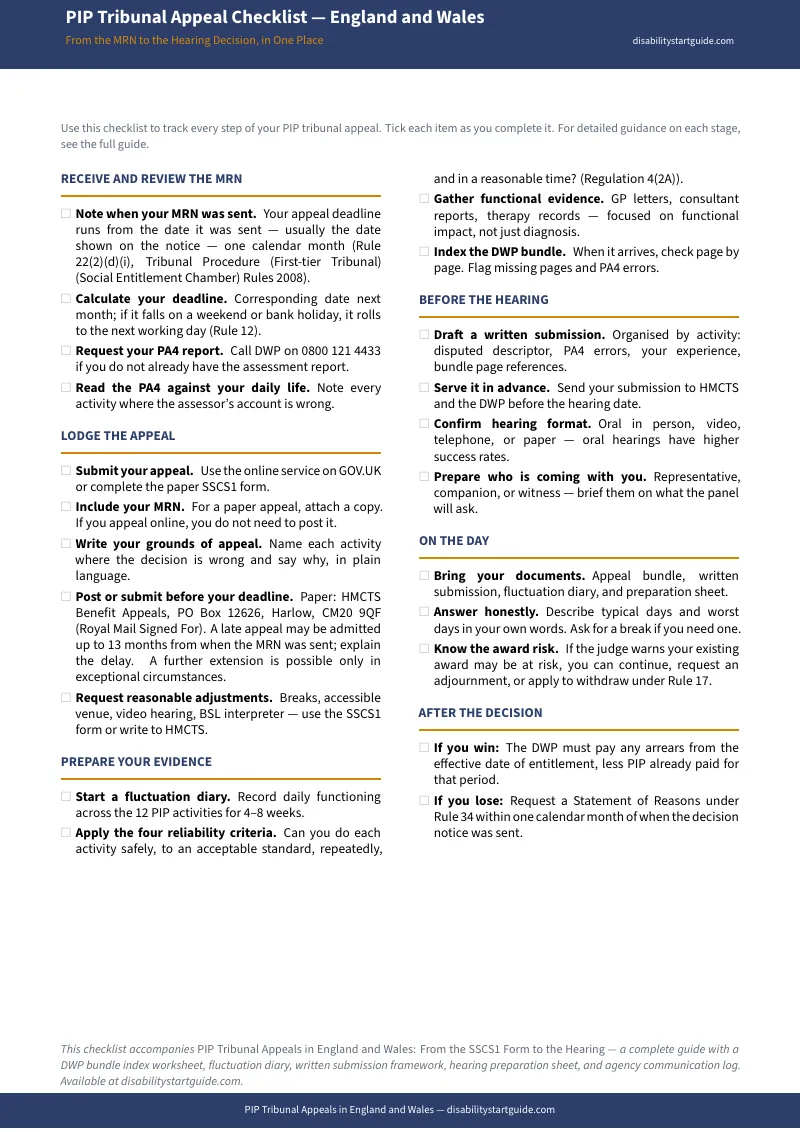
The free checklist covers the deadline, the SSCS1 form, the key stages and a directory of free advice services. The full guide adds the bundle indexing method, the evidence framework, the submission skeleton, the hearing preparation, the award risk assessment and all six worksheets.
Who This Is For
- A disabled person or someone with a long-term condition in England and Wales who has been through mandatory reconsideration and wants to appeal to the tribunal
- A carer, partner, parent or adult child helping someone with a tribunal appeal — the guide is written for both the claimant and the person organising paperwork on their behalf
- Anyone who scored zero or fewer points than expected and whose mandatory reconsideration did not change the decision
- Anyone who has received the DWP response bundle and does not know where to start
- Anyone approaching the one-month appeal deadline who needs a clear, structured way to get the appeal lodged
This guide covers England and Wales only. Scotland uses Adult Disability Payment with appeals through the Scottish Social Security Chamber, and Northern Ireland PIP appeals use form NOA1(SS) through the Appeals Service Northern Ireland.
Why Free Tools Are Not Enough
The SSCS1 form and its guidance booklet are free on GOV.UK. They explain how to lodge the appeal but not how to organise your case once the DWP response bundle arrives. Citizens Advice is excellent — but many local offices have long waiting lists, and your one-month deadline does not wait. Advicenow offers strong guidance on writing a tribunal statement, but not a single workflow that connects lodging, evidence, the bundle, the submission and the hearing.
CPAG publishes detailed technical guidance designed for advice professionals. Forum threads share individual experiences. Benefits and Work offers a subscription library covering multiple benefits. None of them give you a single, linear workflow from the mandatory reconsideration notice to the tribunal decision, with printable tools for each stage.
That is what this guide does. One structured workflow, from the day the MRN arrives to the day the panel gives its decision — and the routes after it.
Satisfaction Guarantee
Full refund, no time limit. If the guide does not help, email [email protected] and you will get your money back.
Get Started
Download the free checklist to see the deadline, the key steps and the free advice directory. When you are ready for the full Tribunal Navigation System — the bundle indexing method, the evidence framework, the submission skeleton and the hearing preparation — get the complete guide, once, yours to keep and print.
Frequently Asked Questions
What if the rules change after I buy?
We update the guide when the rules change. Email us any time, even years later, and we'll send you the current edition free.