You Know What Your Child Needs — The Form Asks You to Prove It
The DomCare1 form asks you to describe your child's daily care needs in your own words — the mornings that take three times as long as they should, the supervision you provide constantly because your child cannot be left alone, the nights you spend awake managing distress or wandering. Then it asks you to explain why these needs are greater than those of any other child the same age. Most parents understate, because chronic exhaustion makes extraordinary care feel routine.
They write "she needs help getting dressed" when the reality is 40 minutes of sensory negotiation, physical guidance, and repeated prompting. They write "he doesn't sleep well" when they are up four times a night soothing, repositioning, preventing wandering. They leave the overnight section thin because they have been doing it for years and forget it counts. The Deciding Officer reads what is written, not what is felt — and the decision comes back: refused, citing insufficient evidence of care "substantially in excess" of age-matched norms.
The DCA Claim Preparation System gives you a structured way to prepare your child's Domiciliary Care Allowance application before you start the official form — so every answer captures what actually happens, not a tired summary drafted at midnight.
What's Inside
- DomCare1 Form Walkthrough — the care-description sections explained in plain language, with what the Deciding Officer looks for and how to describe your child's daily needs accurately and completely using the "substantially in excess" same-age comparison that the Department of Social Protection requires
- Same-Age Care Comparison Worksheet (printable) — a structured grid covering personal hygiene, dressing, mobility, communication, safety, sensory regulation and feeding, with columns for typical peer independence at your child's age and your child's actual needs
- Seven-Day Day and Night Care Log (printable) — a 24-hour diary designed to capture morning routines, daytime supervision, after-school or after-crèche care, evening settling, night-time awakenings, medication and wandering prevention — print one copy per week to build an evidence pattern
- Master Evidence Cover Sheet (printable) — a table-of-contents template for organising clinical reports, Assessment of Need documents, school or SNA letters, therapy evaluations, hospital correspondence and your own care diary, so the Deciding Officer can find the key evidence without reading through a thick bundle
- DCAMed1 and Dom Care 3 Guidance — what the GP or specialist medical report covers, what the optional PDD specialist form adds for autism and related conditions, and how to brief your doctor on translating clinical findings into the care-based language the Department uses
- Submission Audit Checklist (printable) — a step-by-step verification list for MyWelfare online submissions or postal applications to the DCA section in Longford, covering file compression, attachments, proof of posting and expected timelines
- Review and Appeal Guide — what to do if the claim is refused: the difference between a Department review and a formal appeal to the Social Welfare Appeals Office, the 60-day (and conditional 180-day) appeal deadline, what new evidence to gather, and where to get free support
- Linked Supports and Age-16 Transition Roadmap (printable) — what a DCA award unlocks: eligibility to register for a non-means-tested HSE Medical Card through the DCA scheme (HSE registration is required), the €2,000 annual Carer's Support Grant, eligibility for Carer's Allowance and Carer's Benefit, plus a step-by-step timeline for preparing the Disability Allowance application before DCA stops at 16
- Agency Communication Log (printable) — a record of every call, email or letter to or from the DSP, the HSE, schools, therapists and other agencies, with date, method, reference number and what was discussed
Who This Guide Is For
- A parent or carer in Ireland applying for Domiciliary Care Allowance for the first time — whether your child has a formal diagnosis or is still on a waiting list
- A family reapplying after a refusal or preparing for a review, who needs to strengthen the daily care evidence
- A parent of a child with autism, ADHD, Down syndrome, a rare condition or any disability that requires substantially more care than a child of the same age
- A grandparent, partner, separated co-parent or family member helping to fill in the form
- A parent whose child is approaching 16 and needs to prepare for the transition from DCA to Disability Allowance
Why Not Free Resources Alone?
Citizens Information, Family Carers Ireland and other voluntary organisations provide essential free support. We link to all of them throughout the guide and strongly encourage you to use them — they are often the best first stop, especially for families on tight budgets. Official forms are free. Calls to 0818 numbers are standard-rate: they cost no more than a call to a landline and are included in bundles that include landline calls.
What free guides typically do not provide is a structured evidence-preparation system designed for complex care claims. The gov.ie guidance explains the rules clearly but does not include printable care diaries, same-age comparison grids, or evidence cover sheets. Charity factsheets cover the process but rarely offer the detailed day-and-night logging frameworks that help parents capture the care hours they have been normalising for years. This guide sits alongside those resources, not in place of them — it organises the preparation work so that when you sit down with the form (or when a Citizens Information officer sits with you), your evidence file is already built.
One private clinic lists €975 for a child's diagnosis, assessment and full report; DCA medical form completion is listed separately at €75. A clinical report does not replace the parent's care-description sections of DomCare1 — and a strong medical report can still be undermined if the parent's own narrative is vague. This guide costs a fraction of that and keeps you in control of what gets written about your child.
Satisfaction Guarantee
Full refund, no time limit. If the guide is not what you expected, email [email protected] and we will refund you — no form, no deadline, no questions.
Get Started
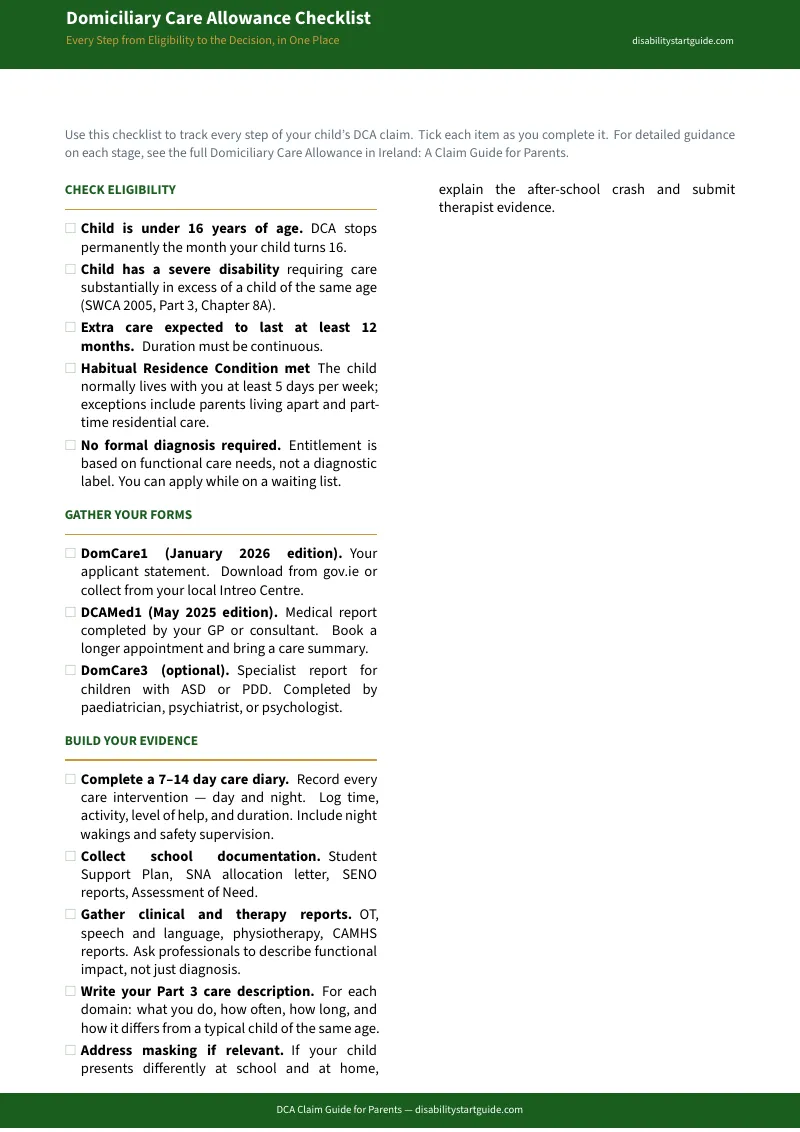
Download the free Domiciliary Care Allowance Checklist to see the eligibility tests, the forms you need and the evidence categories at a glance. When you are ready for the full walkthrough, worksheets and printable tools, the complete guide is available for .
Frequently Asked Questions
What if the rules change after I buy?
We update the guide when the rules change. Email us any time, even years later, and we'll send you the current edition free.