The letter says no. You have 60 days. Where do you even start?
Your child needs extra care every single day — care that goes well beyond what other children the same age need. You know it. Their teachers know it. Their therapists know it. But the Department of Social Protection's Medical Assessor, working from a paper file, decided otherwise.
Now you are holding a refusal letter, a ticking deadline, and a sinking feeling that the system does not see your child's life the way you live it.
The official appeal form gives you a blank box and a 60-day clock. Citizens Information can help you fill it in — and you should absolutely use them. But if you want to work through the process at home, at your own pace, with a structured system for organising your evidence before you walk into that appointment or post that form, this guide was built for exactly that.
The DCA Appeal Evidence System
Most DCA refusals do not happen because the child does not qualify. They happen because the original application described a diagnosis instead of describing daily care. The Medical Assessor is not asking "does your child have autism?" or "does your child have ADHD?" — they are asking "does this child need care substantially in excess of a child the same age, and can the parent prove it?"
The DCA Appeal Evidence System gives you a structured way to answer that question with evidence the Appeals Office actually weighs:
- Refusal-letter guidance — understand the decision letter and Medical Assessor's opinion, identify care needs to address and build your response around the specific gaps
- 7-Day Care Intensity Log — record extra care tasks across morning, daytime, afternoon/evening and night-time, showing the volume of care in a structured format
- Peer Comparison Statement — follow the guide's steps to explain what a child the same age without a disability does independently and what your child needs help with, using concrete examples for the "substantially in excess" test
- Evidence Cross-Reference Index — map care areas to the clinical reports and parental evidence that address them, so you can identify gaps before submitting your evidence bundle
- Section 301 review guidance — learn how to request a Deciding Officer revision alongside your formal SWAO appeal, so you understand both routes and the 60-day appeal deadline
- Oral Hearing Preparation Checklist — organise your documents, structure what you want to say, and prepare for the Appeals Officer's questions, so you walk in calm and ready instead of overwhelmed
- Appeal Timeline and Deadline Tracker, plus Agency Communication Log — record decision and hearing dates, document submissions, acknowledgements and communications with the DSP, SWAO and support services
What the Guide Covers
The full guide walks you through the entire DCA review and appeal process, chapter by chapter:
- How to read the refusal letter and understand what the Medical Assessor actually decided
- Requesting your case file and the Medical Assessor's report
- The Section 301 revision — asking the Deciding Officer to look again with new evidence
- Filing Form SWAO1 within the 60-day appeal deadline (and what happens if you are late)
- Structuring your evidence around the three pillars: daily care intensity, peer comparison, and clinical documentation
- Preparing for and attending an oral hearing at the Social Welfare Appeals Office
- What happens after a successful appeal — arrears, payment start dates, and the Carer's Support Grant
- Further reviews, Section 317 and 318 revisions, and when to consider a judicial review
- The age-16 transition from DCA to Disability Allowance
- Common mistakes that weaken appeals (and how to avoid them)
The guide reflects the current 2026 DCA rate (€380 per month) and cites official sources for the appeal rules. Gov.ie, the Social Welfare Appeals Office and Citizens Information are cited and linked.
Who This Is For
- Parents and guardians who have received a DCA refusal, a lower-than-expected award, or an overpayment notice and want to challenge it
- Co-parents and family members helping to compile evidence and manage the appeal paperwork
- Families waiting on private therapy who need to document care needs while the CDNT waiting list stretches on
- Anyone preparing for an oral hearing who wants to walk in organised rather than anxious
Why Not Just Use Free Resources?
You absolutely should use free resources — and this guide tells you exactly where to find them. Citizens Information centres offer face-to-face help. Family Carers Ireland provides carer support. FLAC runs free legal advice clinics. The guide lists every free service available, with contact details.
What free resources do not give you is a printable organisational system. Gov.ie explains the rules across dozens of pages. Citizens Information explains your rights in general terms. Forum advice from other parents is heartfelt but unstructured and sometimes legally inaccurate.
This guide takes the same statutory rules and organises them into a single, printable workflow with tracking worksheets, evidence templates and step-by-step checklists — so you spend your 60 days building your case, not hunting for information.
Your Purchase Is Protected
Full refund, no time limit. If the guide is not what you expected, email [email protected] and you will receive a full refund — no questions, no deadline.
Start With the Free Checklist
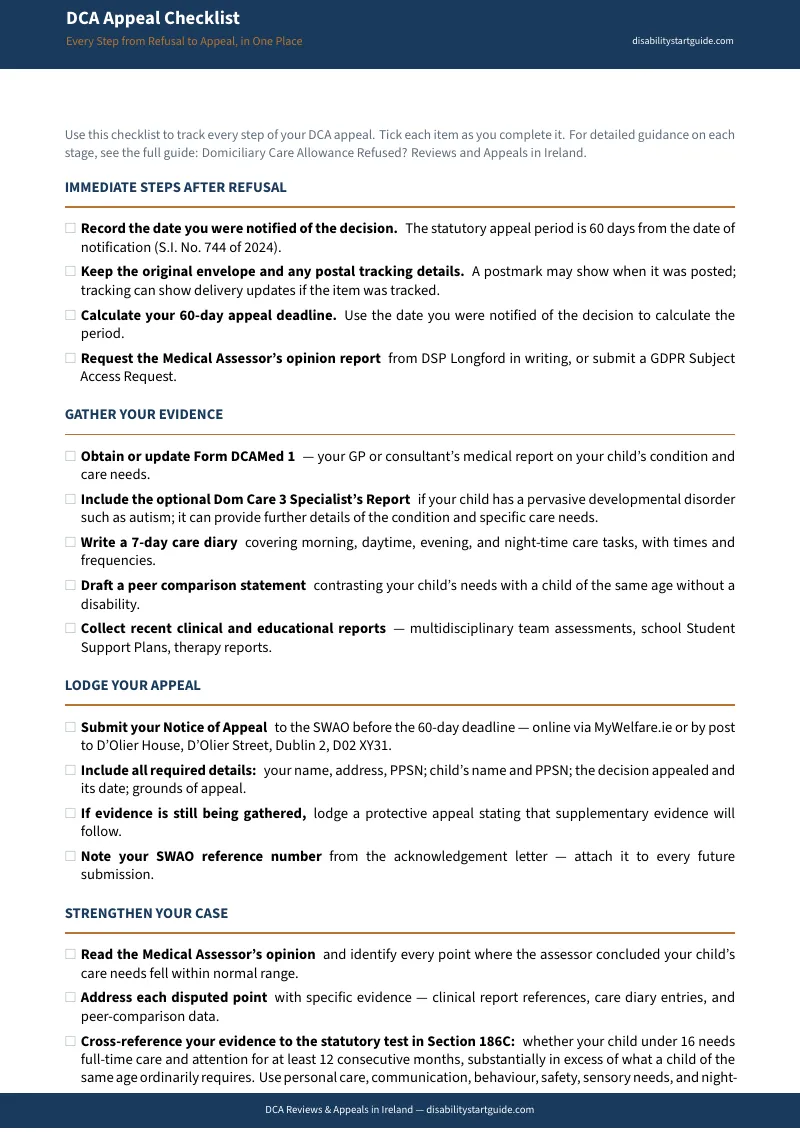
Not sure yet? Download the free DCA Appeal Checklist — a two-page summary of the appeal deadline, evidence steps and free support contacts. It covers what to do; the full guide covers how.
If you are ready for the complete system — the daily care tracker, the evidence cross-index, the oral hearing prep checklist and the step-by-step guide through every stage of the appeal — get the full guide now.
Frequently Asked Questions
Can I find this information for free on gov.ie or Citizens Information?
Yes — every statutory rule, form and deadline in this guide is publicly available. The guide does not contain secret information. Its value is in structuring the full review-and-appeal process into one printable sequence with daily care worksheets, evidence cross-referencing templates and hearing preparation checklists, so you are not assembling the process from scattered official pages under deadline pressure.
Will this tell me what to write so my child gets approved?
No. The guide provides frameworks for recording your child's real daily care needs accurately and completely — including worst days, night-waking and care beyond what a child the same age typically requires. It never suggests exaggerating or inventing symptoms. Eligibility depends on your child's actual care requirements meeting the statutory threshold.
Is this an official government guide?
No. This is an independent organisational guide with no affiliation with or endorsement from the Department of Social Protection, the Social Welfare Appeals Office, Citizens Information or any charity. All official sources are cited and linked.
What if my deadline is nearly up?
Chapter 2 explains how to lodge Form SWAO1 before the 60-day deadline while noting that further evidence will follow. If you have passed the deadline, the guide explains that the Chief Appeals Officer may accept a late appeal with reasonable cause and reasonable, non-trivial, prima facie grounds, up to 180 days from notification.
Does appealing risk reducing a payment I already receive?
If your DCA was refused outright, there is no payment to reduce. If you are appealing a review decision, the guide explains what to expect and how to protect your position.
What about getting a solicitor?
Specialist child-law solicitors handle DCA appeals and can represent you at oral hearings or pursue a judicial review — but their hourly fees put them out of reach for many families. The guide is designed for the majority of appeals where the issue is evidence presentation, not complex legal argument. It also explains when professional legal help is worth considering and where to find free legal advice through FLAC.
Frequently Asked Questions
What if the rules change after I buy?
We update the guide when the rules change. Email us any time, even years later, and we'll send you the current edition free.