The DSP claim process asks for medical evidence you've never had to organise before
You've been told you might qualify for the Disability Support Pension — or you've already started the myGov claim and hit a wall. The forms ask whether your conditions are "diagnosed, reasonably treated and stabilised." The Impairment Tables scoring system has 15 tables with descriptors you've never seen. You need 20 points, but nobody has explained what that actually means for your condition. Meanwhile, you're reading contradictory advice online, some of it based on rules that changed in April 2023.
The DSP claim is not a single form. It's a months-long process involving medical evidence from treating doctors, a possible Job Capacity Assessment, a possible Disability Medical Assessment by Sonic HealthPlus, the Program of Support rules, and income and assets testing — each with its own requirements that Services Australia doesn't explain in one place.
The DSP Evidence and Claim Navigator
This guide puts the entire DSP claim process in order — from checking whether you meet the medical and non-medical rules, through gathering the right evidence, to lodging through myGov, preparing for assessments, and knowing what to do if the claim is refused. It's written for the person applying and the family member or carer helping with the paperwork.
Everything reflects the 2023 Impairment Tables Determination, the Administrative Review Tribunal (which replaced the AAT in October 2024), and the November 2025 employment service transitions to Inclusive Employment Australia and the Remote Australia Employment Service.
What's Inside
- The medical eligibility rules in plain language — what "diagnosed, reasonably treated and stabilised" actually means under the current standard, how it differs from the old "fully treated" rule, and when a condition still on a treatment waitlist can qualify
- A plain-language walk-through of the 15 Impairment Tables — how the 20-point threshold works across single and multiple conditions, which tables apply to which conditions, and how the functional descriptors translate to daily life
- The evidence your treating doctors need to provide — what Services Australia assessors look for in medical reports, why diagnosis alone is not enough, and how to help your doctor describe your functional limitations using the language the tables use
- The myGov claim step by step — the forms, the uploads, what to have ready before you start, and common mistakes that delay processing
- JCA and DMA assessment preparation — what happens at each assessment, what the assessor is measuring, and how to describe typical days, worst days and fluctuating symptoms accurately and completely
- The Program of Support rules — when you need one, who is exempt (including the single-table 20-point exemption), and how Inclusive Employment Australia and RAES participation counts
- Income and assets testing — how the means tests work, how payment rates are set, the Work Bonus for DSP recipients at Age Pension age, and how DSP interacts with Carer Payment in the same household
- What to do if your claim is refused — the internal review process, taking a case to the Administrative Review Tribunal, gathering fresh evidence, and where to find free legal help through Legal Aid, Economic Justice Australia and community legal services
Plus 7 printable planning tools: a medical evidence index matrix, a functional impact worksheet, a submission and assessment tracker, an assessment preparation checklist, an income and assets worksheet, a post-decision action map, and the DSP process checklist.
Who This Guide Is For
- A disabled person or someone with a long-term health condition in Australia who is about to apply for the DSP or has just started the claim
- A family member, partner or unpaid carer helping someone with the forms and evidence gathering
- Someone whose DSP claim was refused and who wants to understand the review and appeal options
- Anyone on JobSeeker with a medical condition who is considering whether the DSP is the right next step
Why Not Just Use the Services Australia Website?
Services Australia publishes every rule — spread across dozens of web pages, each written for a different audience (claimants, health professionals, employers), in language drawn from the Social Security Act. The eligibility rules are on one page, the Impairment Tables on another site entirely, the assessment process on a third, and the appeals pathway on a fourth. The official guidance tells you what the rules are. This guide puts them in the order you actually need them, in the language you actually use, with the evidence preparation and assessment strategies that the official pages don't cover.
Cheap templates on Etsy and Gumroad often still reference the pre-2023 "fully diagnosed, treated and stabilised" standard or the abolished AAT. Some offer fill-in-the-blank symptom scripts that assessors dismiss on sight. This guide contains no scripts — it teaches you to describe your own daily life accurately, which is what the process actually rewards.
Satisfaction Guarantee
Full refund, no time limit. If the guide doesn't help, email [email protected] and you'll get your money back. No form, no questions.
Get Started
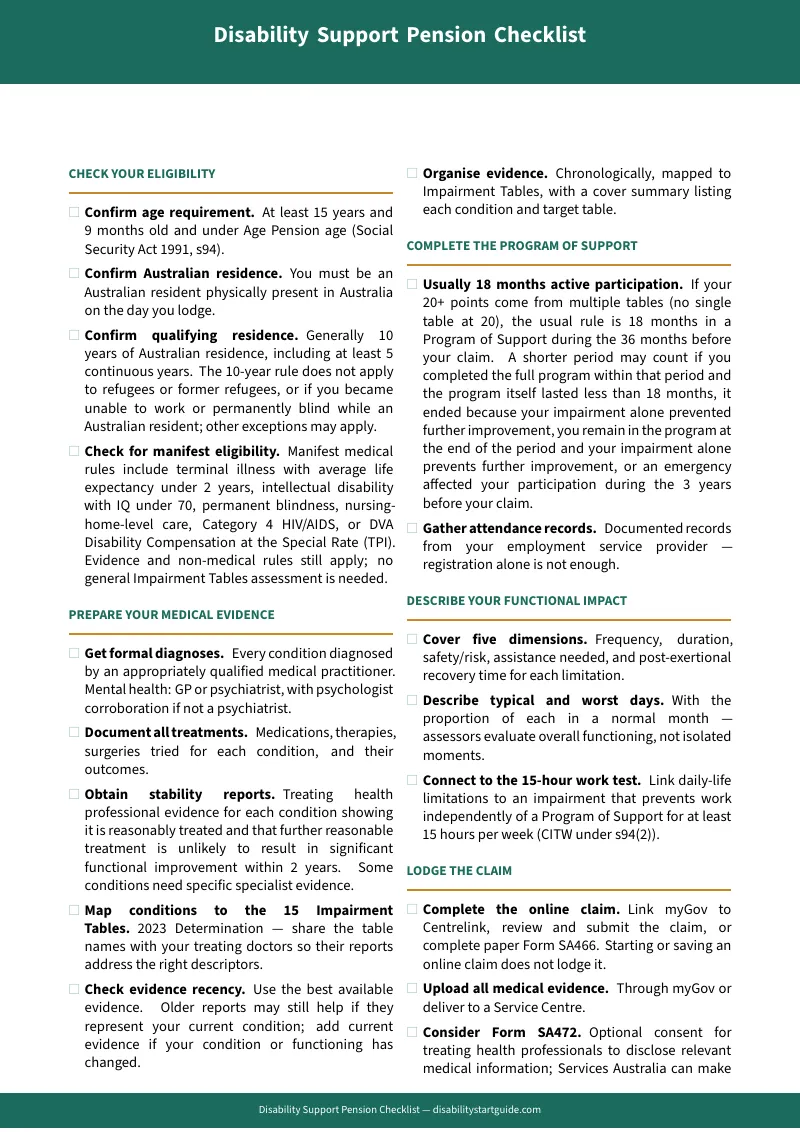
Download the free DSP checklist to see the eligibility rules, evidence list and key steps at a glance. Ready for the full guide? Get the complete DSP Evidence and Claim Navigator with every chapter, all 6 printable worksheets and the checklist.
Frequently Asked Questions
What if the rules change after I buy?
We update the guide when the rules change. Email us any time, even years later, and we'll send you the current edition free.