You already know something has to change — you just need to know the steps
You are caring for someone around the clock: helping them wash, dressing wounds, managing medications, supervising every room of the house. You have cut your working hours or stopped entirely. The savings are draining. And somewhere in the back of your mind is the question you keep putting off — am I eligible for Carer Payment, and how on earth do I prove it?
Services Australia spreads the rules across dozens of pages. The care questionnaire. Any medical report requested from the care receiver's treating health professional. The income test for you and the assets test for the person you care for. The 100-hour participation rule that replaced the old 25-hour limit. Respite days. Hospitalisation rules. Each page assumes you already understand the others.
This guide puts the entire Carer Payment claim process in one place — from the first eligibility check to what to do if you are refused — so you can prepare a thorough, honest application without spending weeks untangling government web pages while exhausted from caring.
The Claim Assembly System
Most carers do not fail the eligibility criteria. They fail the paperwork. A care questionnaire that does not describe the worst days. A treating health professional who was not briefed on what the SA332A medical report for an adult care receiver aged 16 or over needs to cover. Hours logged the wrong way under the new participation rules. Assets counted that should have been excluded.
The Carer Payment Claim Assembly System gives you the structure to get it right the first time — not by telling you what to write, but by showing you what each form is looking for and helping you organise your evidence before you sit down at myGov.
What's inside
- Eligibility pathway check — a decision tree that separates the adult pathway (ADAT) from the child pathway (DCLA) so you know exactly which forms apply to your situation before you start
- Care questionnaire walkthrough — each section of the Adult Disability Assessment Tool and Disability Care Load Assessment explained in plain language, with guidance on describing physical care, cognitive supervision and behavioural support on typical and worst days
- Treating health professional preparation sheet — a one-page summary to take to an appointment if a report is requested for an adult care receiver aged 16 or over, so they understand what the SA332A medical report needs to cover and the appointment is not wasted on the wrong details
- 7-day care diary template — a structured daily log that captures physical assistance, guidance, supervision and overnight care so you have concrete evidence ready when Centrelink asks how many hours you provide
- 100-hour participation ledger — a 4-week tracking sheet for paid work hours that correctly excludes study, training, volunteering and travel, so you stay within the participation limit without second-guessing every shift
- Dual means test worksheets — separate worksheets for the carer income and assets test and the care receiver's non-customer assets and income limits, including deeming rates and the $886,750 threshold, so you know where you stand before you submit
- Respite and hospitalisation tracker — a calendar-year log for the 63 temporary cessation of care days and, for care receivers aged 16 or over, up to 63 hospitalisation days, so you never accidentally exhaust your allowance without realising
- Carer Supplement and payment interaction guide — how Carer Payment interacts with Carer Allowance, the annual Carer Supplement, the Pensioner Concession Card and Age Pension transfer, so you understand the full picture of what you may receive
- Refusal response roadmap — what to do if your claim is rejected, from requesting an Authorised Review Officer (ARO) internal review to applying to the Administrative Review Tribunal, with the deadlines and what each stage examines
Who this is for
- Unpaid carers providing constant daily care to a partner, parent, child or friend with a disability, severe medical condition or frailty
- Adult children managing a Carer Payment application for an ageing parent — gathering documents, uploading to myGov and coordinating medical appointments
- Working carers who need to stay under the 100-hour participation limit while keeping enough income to cover the bills
- Parents of a child with a disability or medical condition navigating the Disability Care Load Assessment and child-specific forms
- Anyone who has been refused Carer Payment and wants to understand why and what they can do about it
Why not just use the free government information?
You should. Services Australia is the authority, and every rate and rule in this guide comes from their published policy. The guide links to every official source it draws on.
What Services Australia does not give you is a single organised workflow. The eligibility rules are on one page, the care questionnaire instructions on another, the income test on a third, the assets test on a fourth, the participation rules on a fifth, respite on a sixth. Each page is written for policy completeness, not for a carer sitting at the kitchen table after a long day trying to figure out what to do next.
This guide takes the same information and puts it in the order you actually need it — with printable worksheets so you can prepare offline, a doctor prep sheet so you do not waste a short medical appointment, and tracking logs so you do not trip over the participation or respite rules months after your claim is approved.
What this guide does not do
It does not give legal or medical advice. It does not promise you will be approved or receive a specific amount. It does not provide scripted answers for the care questionnaire — the strongest applications are honest ones that describe real daily care completely. And it is not affiliated with Services Australia, Centrelink or any government agency.
Free help is always available. Services Australia can be reached on 13 27 17. Carer Gateway provides free counselling and respite referrals on 1800 422 737. Economic Justice Australia can connect you with member centres, including state Welfare Rights Centres, that provide free legal advice on social security decisions. The guide lists key free services so you know your options.
Full refund, no time limit
If the guide is not useful, email [email protected] for a full refund. No time limit, no questions, no forms to fill in.
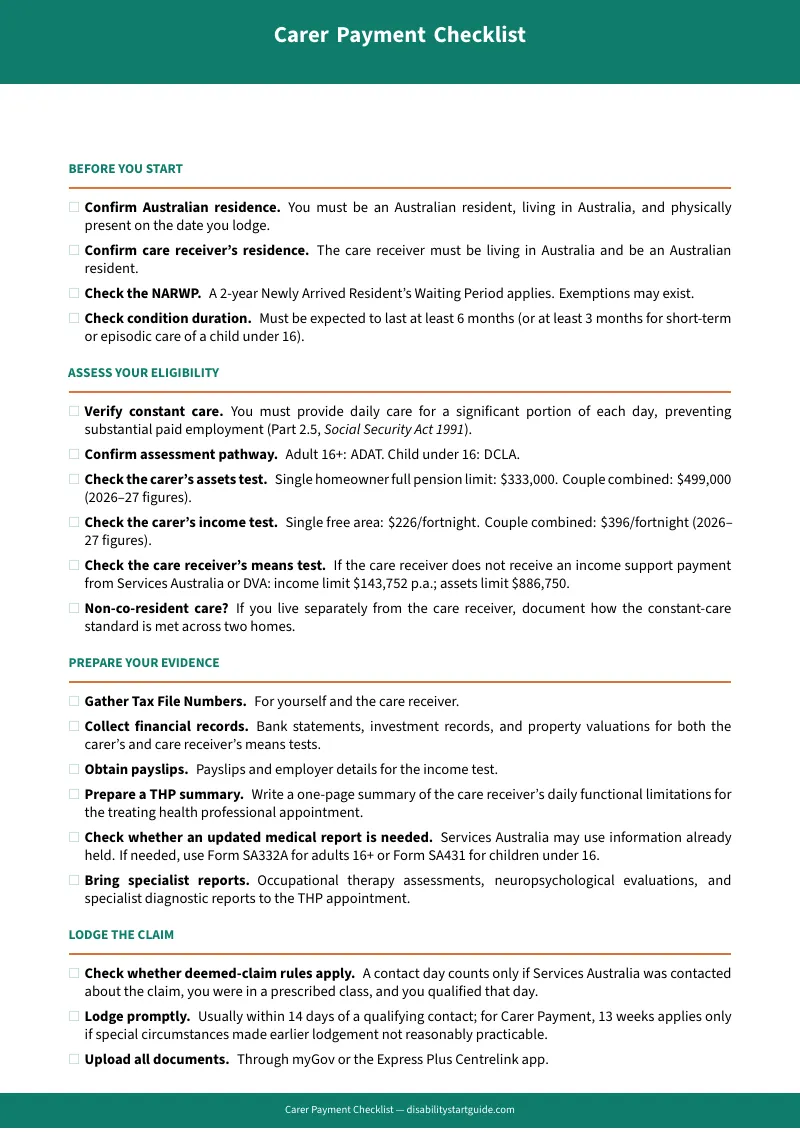
Or start with the free checklist — a two-page overview of every document, form and step in a Carer Payment claim — and decide from there whether the full guide would help.
Frequently Asked Questions
What if the rules change after I buy?
We update the guide when the rules change. Email us any time, even years later, and we'll send you the current edition free.