Your parent needs help getting dressed, getting to the bathroom at night, remembering to take medication — and the form asks you to put all of that into words
Pension Age Disability Payment could mean £76.70 or £114.60 a week, tax-free, for your parent or the person you care for. But between the two-part application, the eight-week deadline, and questions that ask about daytime attention and night-time supervision separately, families often stall — unsure how to describe what is actually happening in a way that meets Social Security Scotland's criteria.
Free advice services like Citizens Advice Scotland and Age Scotland are excellent, but appointment waits can stretch into weeks. The official mygov.scot pages explain the legal rules without showing you how to turn a day of helping someone wash, dress, eat and stay safe into a clear, honest account of care needs. And old Attendance Allowance guides from England still rank in search results, sending Scottish families down the wrong path entirely.
The PADP Day-and-Night Care Planner
This guide was built around one problem: families know the care they give, but they do not know how to write it down in a way that matches what Social Security Scotland needs to see. The Day-and-Night Care Planner is a structured framework that walks through every part of a typical 24 hours — morning personal care, daytime attention, evening routines, night-time supervision — so nothing gets left off the form.
It is not a script. It does not tell anyone what to say. It gives you and the person you are helping a way to describe what actually happens, accurately and completely, on a typical day, on a bad day, and at night.
What's Inside
- Eligibility self-check — confirm State Pension age and Scottish residency, and understand the 26-week care-needs period, including how an early application can be made
- Two-part application walkthrough — what Part 1 asks, what Part 2 asks, how the eight-week deadline works, and how to ask Social Security Scotland for more time if you need it
- Day-and-Night Care Planner — structured prompts covering personal care (washing, dressing, eating, toileting, mobility), supervision (fall risks, confusion, wandering), and night-time needs, so you can describe the full picture that determines whether the lower or higher rate applies
- Supporting information guide — who counts as a professional for the confirmation Social Security Scotland requests, how the Statement of Support works for family and carers, and the 28-day window after Part 2 for getting documents in
- Case transfer explained — what the automatic transfer from DWP Attendance Allowance to PADP means, why your award rate is protected at transfer, and what to do if a future review is scheduled
- Cross-border rules — what happens if you move to Scotland from elsewhere in the UK, or if you move out of Scotland while claiming PADP, including the 13-week transition arrangements
- Challenge roadmap — the 42-day redetermination window, how to request one, what Short-term Assistance is and when it applies, and the route to a First-tier Tribunal appeal
- Linked benefits breakdown — how a PADP award can increase Pension Credit, enable someone caring for you to claim Carer Support Payment, and support applications for Council Tax Reduction
- Five printable worksheets — a 24-Hour Care Audit Log, Evidence Gathering Tracker, Cross-Border Move Checklist, Challenge Action Planner and Agency Communication Log, each a separate PDF you can print and fill in at the kitchen table
Who This Guide Is For
- An adult son or daughter filling in the PADP forms for a parent who has reached State Pension age and needs daily help or overnight supervision
- A partner or spouse applying alongside someone with arthritis, dementia, Parkinson's, mobility loss, sensory impairment or another long-term condition
- Anyone whose DWP Attendance Allowance has transferred to Social Security Scotland and wants to understand what has changed and what stays the same
- A family preparing for a redetermination or appeal after a PADP decision they believe is wrong
Why Not Just Use the Free Information?
The free information is valuable — and this guide tells you exactly where to find it. Citizens Advice Scotland, Age Scotland, and Advocacy.Scot all offer support, and Social Security Scotland itself provides local advisers who can help in person.
What those sources do not give you is a single document that puts the whole process in order: eligibility, both parts of the application, the care descriptions that determine the rate, the evidence deadlines, the transfer rules, and the challenge process. Official guidance explains each rule on a separate page. Charity factsheets cover their own angle. The Day-and-Night Care Planner brings it together so you can work through it at the kitchen table, at your own pace, without waiting for an appointment.
What This Guide Is Not
This is an independent process guide. It is not published by Social Security Scotland, the DWP, Age Scotland, or any charity. It does not give medical or legal advice. It does not promise an award or a particular rate. It shows you how to describe care needs honestly and completely, and it lists the free services available for anyone who needs representation or specialist advice.
If the guide does not help, you get a full refund — no time limit, no questions. Email [email protected] and we will sort it out.
The Free Checklist
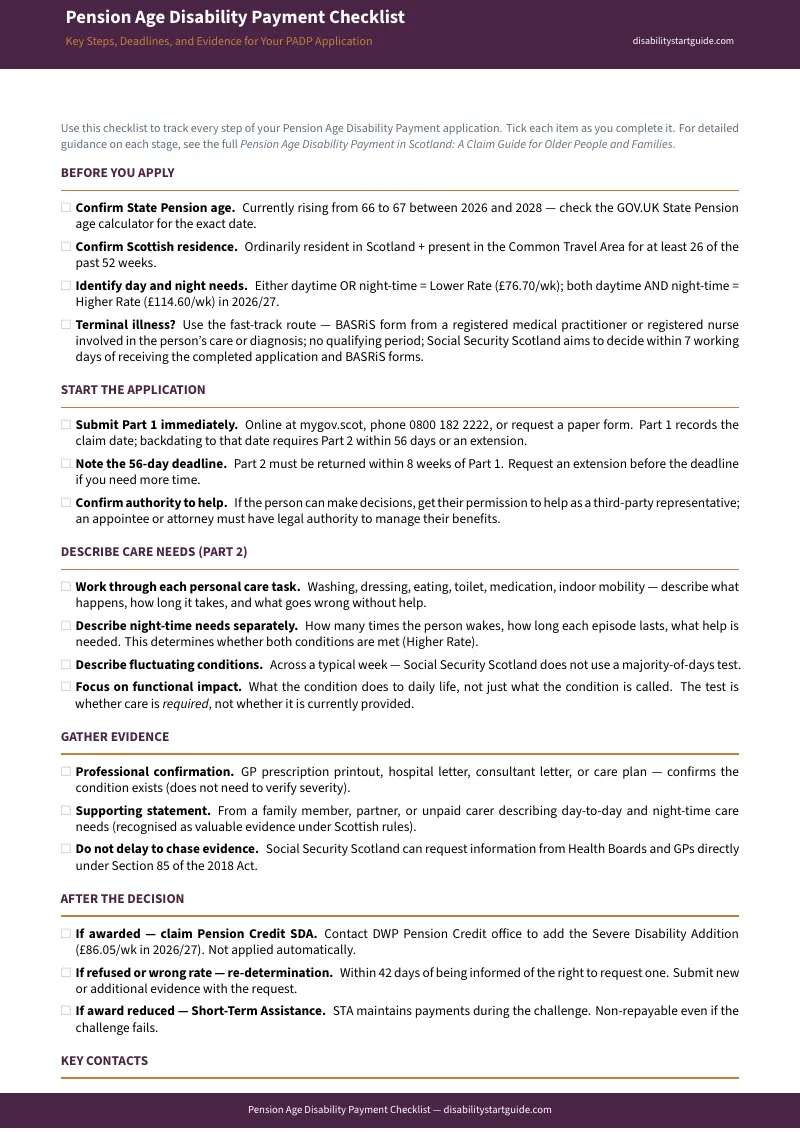
Not ready for the full guide? Download the free Pension Age Disability Payment Checklist — a two-page overview of eligibility points, application routes, supporting information types and key deadlines. It is enough to see whether PADP applies and what the first steps look like.
The full guide picks up where the checklist leaves off, with the Day-and-Night Care Planner, the evidence framework, worked examples, and every deadline mapped out.
What a PADP Award Is Worth
The lower rate pays £76.70 a week (£3,988.40 a year). The higher rate pays £114.60 a week (£5,959.20 a year). Both are tax-free and do not count as income for means-tested benefits. A successful claim can also unlock additional Pension Credit, Carer Support Payment for someone who looks after you, and possible Council Tax Reduction — the guide explains how each one connects.
For less than the cost of a single hour of paid advice, this guide gives you the framework to put together a thorough, honest application — or to prepare for a challenge if the first decision was wrong.
Frequently Asked Questions
What if the rules change after I buy?
We update the guide when the rules change. Email us any time, even years later, and we'll send you the current edition free.