Your child needs more care than other children their age — but putting that on paper is a different challenge entirely
You know the reality of your days. The supervision that never lets up. The nighttime checks. The meltdowns that mean a trip to the shops takes twice as long and three times the energy. You know your child needs more support than their classmates — their teachers know it, their GP knows it.
But when you sit down with the Child Disability Payment application, the questions ask you to explain all of that in a way you have never had to before. How often does your child need help during the day? How do their needs compare to a non-disabled child the same age? What happens at night? Social Security Scotland's case managers make their decision based on what you write — and most parents understate their child's needs because they have normalised the level of care they provide.
The Scottish Care Evidence System — a structured way to document what your family actually lives
This guide does not tell you what to write. It gives you a system for capturing what is already true about your child's daily life, so nothing important gets left out of Part 2.
The Scottish Care Evidence System works through the application methodically: it shows you how Social Security Scotland's care and mobility tests work, what "substantially more care than a child of the same age" means in practice, and how to describe daytime attention, nighttime interventions, and outdoor supervision in the detail that case managers look for — without overstating or understating anything.
Every section is written for Scotland's devolved system. The rules here are different from DLA in England and Wales. The forms are different. The assessment approach is different. And the transition at 16 and 18 is different. This guide covers Child Disability Payment as Social Security Scotland administers it, not a UK-wide approximation.
What's inside the guide
- Part 1 and Part 2 walkthrough — what each part of the application asks, the 42-day Part 2 deadline, and how to request an extension without giving a reason, so your effective date is protected
- Care component evidence framework — how to describe daytime attention, continual supervision, and repeated or prolonged nighttime care, mapped to the lowest, middle, and highest care rates
- Mobility component evidence framework — documenting outdoor walking limits, guidance and supervision needs, and severe behavioural difficulties, mapped to the lower and higher mobility rates
- 7-day care diary guidance — structured day-and-night logging that separates daytime help from nighttime interventions, so the case manager sees the full picture across good days, typical days, and difficult days
- Supporting information strategy — what to ask teachers, therapists, social workers, and GPs to say in their statements, and how Social Security Scotland weighs professional evidence alongside your own account
- No-diagnosis claims — how to apply when your child is on an NHS waiting list without a formal diagnosis, because CDP is awarded on functional care needs, not diagnostic labels
- Decision, rates, and passported benefits — current 2026/27 weekly rates from £30.30 to £194.60, how combined awards work, Carer Support Payment eligibility, Blue Badge links, and other entitlements an award unlocks
- Reviews and renewals — what happens when Social Security Scotland reviews the award, how to report changes, and what the scheduled review process looks like
- Redetermination basics — what to do if the initial decision awards a lower rate than expected or refuses the claim, and when to request a formal redetermination
- Age 16–18 transition — comparing staying on CDP until 18 against applying early for Adult Disability Payment at 16, with a decision framework for weighing the options
- Special rules for terminal illness — the BASRiS fast-track process, automatic highest care from birth and higher mobility from age 3, seven-working-day processing target, and backdating
Plus five standalone printable worksheets:
- Application Timeline Tracker — fill-in sheet for every date from Part 1 to determination and post-award actions
- Care and Mobility Evidence Log — structured 7-day diary for recording daytime care, nighttime interventions, and outdoor mobility
- Supporting Information Request Template — a ready-to-use letter to give teachers, GPs, and therapists
- Age 16–18 Transition Decision Matrix — comparison worksheet for weighing CDP against early Adult Disability Payment
- Decision Challenge Preparation Checklist — step-by-step preparation for requesting a Re-determination
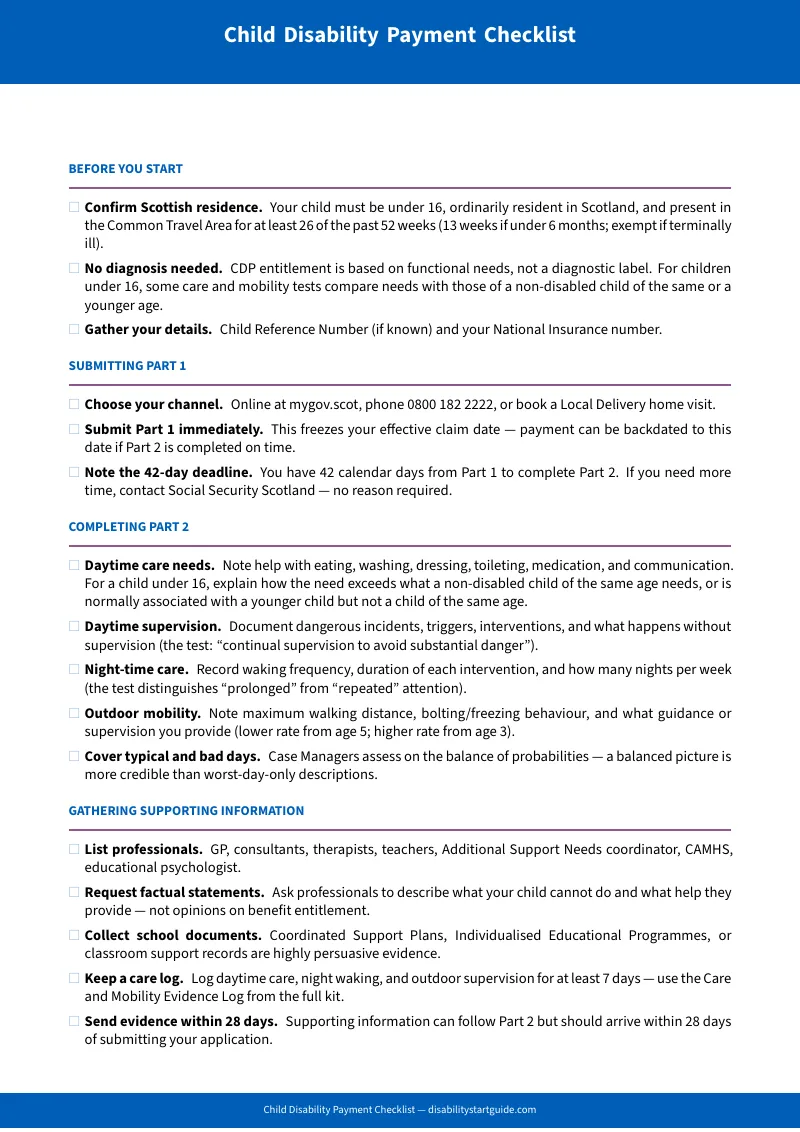
And a printable Child Disability Payment Checklist — a two-page summary of the application stages, the evidence to gather, and the key deadlines, available as a free download.
Who this guide helps
- Parents applying for Child Disability Payment for the first time, whether your child has a diagnosis or is still on a waiting list
- Carers or family members helping someone complete the Part 2 application
- Families reapplying after a previous refusal who want to understand where the evidence fell short
- Parents preparing for a scheduled review who need to document how care needs have changed
- Families with a young person approaching 16 who need to understand the transition choices
Why not rely on free resources alone?
Free resources for Child Disability Payment exist and they are good. The mygov.scot pages explain every eligibility rule. Citizens Advice Scotland and local welfare rights services offer free one-to-one help. Contact's downloadable guides cover the application in detail. Social Security Scotland's Local Delivery Service will even help you fill in the form at home.
This guide is not a substitute for any of them — it is an organising layer that sits alongside them. The official pages tell you what the rules are. This guide helps you prepare your evidence before you open the application or walk into an advice appointment: what to capture in a care diary, what a strong supporting letter from school actually says, how to describe fluctuating conditions without understating them or overstating them.
The gap is not information — it is structure. Parents who have used free advice services say the hardest part was knowing what to bring to the appointment. Parents who completed the form independently say the hardest part was describing their child's daily care in enough detail. The guide addresses both.
What this guide does not do
It does not give legal or medical advice. It does not tell you what to write to get a particular outcome — pre-scripted answers are counterproductive and can undermine a claim. It does not promise an award or a specific rate. And it is not affiliated with Social Security Scotland, the DWP, Citizens Advice, or any charity.
It explains the process in plain language, shows you how to describe your child's needs accurately and completely, and signposts the free help available at every stage.
Full refund, no time limit
If the guide is not right for your situation, email [email protected] for a full refund — no time limit, no questions.
The free Child Disability Payment Checklist is available to download without buying anything. If you want the full evidence system, the guide is here when you are ready.
Get the Child Disability Payment Guide →
Frequently Asked Questions
What if the rules change after I buy?
We update the guide when the rules change. Email us any time, even years later, and we'll send you the current edition free.