You've got the award letter. Now what?
You or someone you care for has been awarded Adult Disability Payment, PIP, or Child Disability Payment — or you're living with a condition that makes every trip to the car park a calculation of pain, distance and risk. You know a Blue Badge would change things. But the application isn't as simple as ticking a box.
Scotland has its own eligibility rules, its own statutory instruments, and 32 councils that each handle applications their own way. The national portal tells you what the rules are. It doesn't tell you which activity scores actually passport you, what happens when your points fall in the gap between the award rate and the Blue Badge threshold, or how to structure your evidence when you have to apply through the assessed route.
The Scottish Badge Navigator — every route, every council, one guide
This is the guide that sits between the award letter and the application form. It maps every eligibility route in Scottish law — automatic passporting through ADP, PIP, CDP and DLA, assessed physical walking, the Risk in Traffic pathway for cognitive and mental health conditions, temporary badges, and the under-three medical route — and shows you exactly what each one requires.
Where free resources list the rules, this guide explains what happens when the rules don't quite fit your situation. What if your ADP score is high enough for enhanced-rate mobility but the wrong descriptors for automatic passporting? What if your condition fluctuates and some days you can walk and some days you can't? What if you need the paper-based Risk in Traffic form but your council's website doesn't make it easy to find?
What's inside
- The ADP and PIP score decoder — the guide breaks down the specific activity scores, descriptor letters and point thresholds that trigger automatic eligibility, including the ADP criteria in SSI 2022/31, so you can read your own determination letter and know immediately whether you qualify without a council assessment
- Assessed route evidence structuring — for discretionary applications where there's no passporting benefit, the guide explains what councils look for in clinical evidence, how to describe walking distance, speed, manner, time, pain and breathlessness without exaggeration, and which documents carry weight with assessors
- The Risk in Traffic pathway — Scotland's paper-based route for cognitive and mental health conditions is one of the most confusing parts of the scheme, requiring a specific council form, a professional countersignatory, and evidence tied to Section 328 of the Mental Health (Care and Treatment) (Scotland) Act 2003. The guide walks you through every step
- Council variation notes — the guide summarizes how fee caps, Risk in Traffic form availability, assessment arrangements and communication can vary, with examples from selected councils
- The refusal review toolkit — ordinary eligibility refusals don't carry a statutory appeal right, but councils operate their own internal review procedures. The guide explains how to identify what went wrong, what new evidence to gather, and how to lodge a reconsideration request within your council's deadline
- Renewal and return rules — when to renew, what happens if your underlying benefit ends, and the legal duties around returning a badge you're no longer entitled to hold
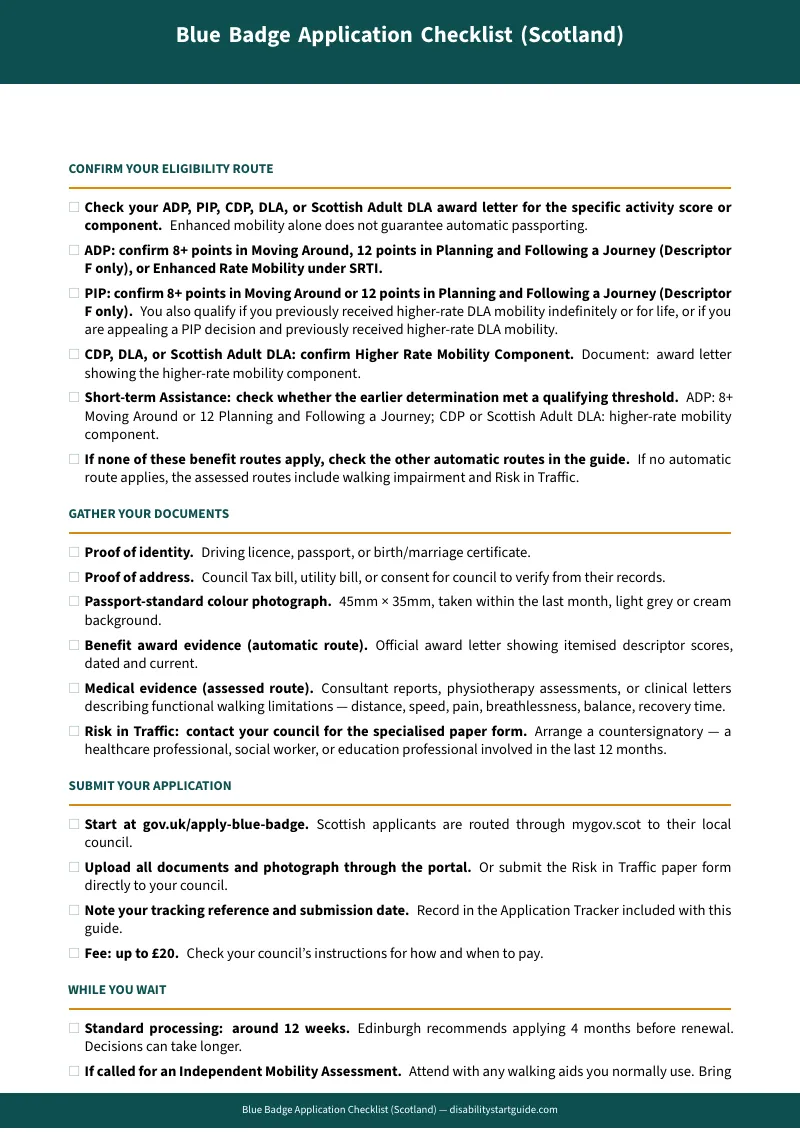
- Pre-submission document audit checklist — a printable verification sheet for identity proofs, address documents, benefit award evidence, medical evidence, photos and Risk in Traffic countersignatory details
- Application tracking guidance — the guide explains how to log submission dates, tracking references, council contacts, evidence sent, assessment and decision dates, and review deadlines
Who this is for
- A disabled person in Scotland applying for a Blue Badge for the first time, whether automatically through a benefit or via the assessed route
- A family member or unpaid carer filling in the application on someone's behalf and gathering the evidence
- A parent applying for a child's Blue Badge through CDP, DLA or the under-three medical route
- Someone whose Blue Badge was refused and who wants to understand the council's review process before reapplying
- An existing badge holder approaching renewal who needs to re-establish eligibility under current rules
Why not just use the free information?
You absolutely can. mygov.scot, Citizens Advice Scotland, Disability Information Scotland and your local council all provide accurate, freely accessible guidance. The guide does not replace them — it cites them.
What the guide does is connect the pieces. Official portals explain each rule separately. The guide puts one application in order: from checking your scores, to gathering evidence, to understanding what the council's assessor is looking for, to knowing your options if the answer is no. It's the difference between having the ingredients and having the recipe.
West Dunbartonshire Council warns that some non-affiliated websites charge up to £49 for Blue Badge application assistance, even though applicants can apply for no extra charge. This is a reference document you own and use at your own pace. It does not submit anything on your behalf and does not claim any connection to any council or government body.
What this guide is not
This is not legal advice. It is not medical advice. It does not guarantee that any application will succeed, and it cannot predict how your council will assess your evidence. It is not affiliated with Social Security Scotland, the DWP, Transport Scotland or any local authority. It will never tell you to exaggerate symptoms or misrepresent your condition — the guide explains how to present accurate, complete evidence of how your condition affects daily life.
Free application advice is available from Citizens Advice Scotland. The guide also lists local welfare-rights services, Disability Equality Scotland and condition-specific charities to contact about support.
Satisfaction guarantee
If the guide doesn't help, email [email protected] for a full refund, no time limit. We read every message.
Start your application with clarity
The free checklist gives you a one-page summary of eligibility routes, evidence types and steps. The full guide gives you everything you need to understand your route, structure your evidence and navigate your council's process from start to finish.
Get the Blue Badge Scotland Guide →
Frequently Asked Questions
What if the rules change after I buy?
We update the guide when the rules change. Email us any time, even years later, and we'll send you the current edition free.