
If you qualify and both statutory tests are met, your council must approve a DFG. The process makes it feel like they'd rather you gave up.
You know the grant exists. You may have already spoken to an occupational therapist, or you are still waiting for a home visit that was promised months ago. Between the OT assessment, the financial means test, the contractor quotes and the council's approval process, the DFG system feels designed to test your patience as much as your eligibility.
Half the difficulty is working out who does what. In a two-tier council area, social services handles the OT assessment while the housing department handles the grant — and neither department considers itself responsible for telling you what the other one needs. Applications stall in this gap every day.
The other half is the paperwork you did not know you needed: bank statements arranged the way the council's finance officer expects them, evidence of daily barriers written in the language the OT assessment actually measures, and at least two contractor estimates that match a schedule of works you have not seen yet.
The DFG Process Navigator — every stage, every deadline, every document in one guide
The Disabled Facilities Grants in England guide takes the entire DFG process — from the first phone call to social services through to the builder's final sign-off — and breaks it into a clear sequence of steps with the statutory deadlines, the documents you need at each stage, and the worksheets that keep the whole thing on track.
This is not a summary of what the grant is. GOV.UK already does that in a few paragraphs. This is the operational manual for getting through the process without losing months to avoidable delays, missing deadlines or discovering too late that you needed a document the council never mentioned.
What's inside the guide
- Eligibility and the Section 23 statutory purposes — who qualifies, what the grant covers (ramps, stairlifts, level-access showers, kitchen adaptations, extensions), and the specific rules for tenants, owner-occupiers and landlord applications
- OT Need Preparation Worksheet — a room-by-room framework for documenting your daily barriers accurately and completely before the home visit, so the assessment captures the full picture on the day, not just the good moments
- The means test demystified — which benefits passport you through with no financial assessment, how the capital thresholds work, the income disregards, and the exemption for children under 16 and qualifying young people aged 16 to under 20, whose parents' income and capital are disregarded in the means test
- The 6-month statutory decision clock — when it starts, when the council must issue its decision under Section 34, and exactly what to do with the Statutory Timeline Tracker and Complaint and Ombudsman Escalation Log when the clock runs past six months
- Contractor quotes and the schedule of works — how to gather quotes that match what the council specified, what happens when estimates exceed the £30,000 cap, and why starting work before written approval puts the entire grant at risk
- Discretionary top-ups under the Regulatory Reform Order 2002 — how to request additional funding when the adaptation costs more than the statutory maximum, and what councils consider when deciding
- Local land charges explained — the 2008 General Consent, the £10,000 recovery cap, the 10-year condition period for owners, and the hardship and health grounds for requesting a waiver
- Complaints and escalation framework — internal council complaints, referral to the Local Government and Social Care Ombudsman, and when judicial review applies, with the Complaint and Ombudsman Escalation Log that documents every delay
- Tenure-specific guidance — separate sections for private tenants (landlord consent, Equality Act duties, tenant certificates), housing association tenants, and owner-occupiers, so you follow the rules that apply to your situation
- Legal Authority Worksheet — lasting powers of attorney, court-appointed deputies, and what a DWP appointeeship does not cover, for applications where the disabled person cannot sign themselves
The free checklist vs the full guide
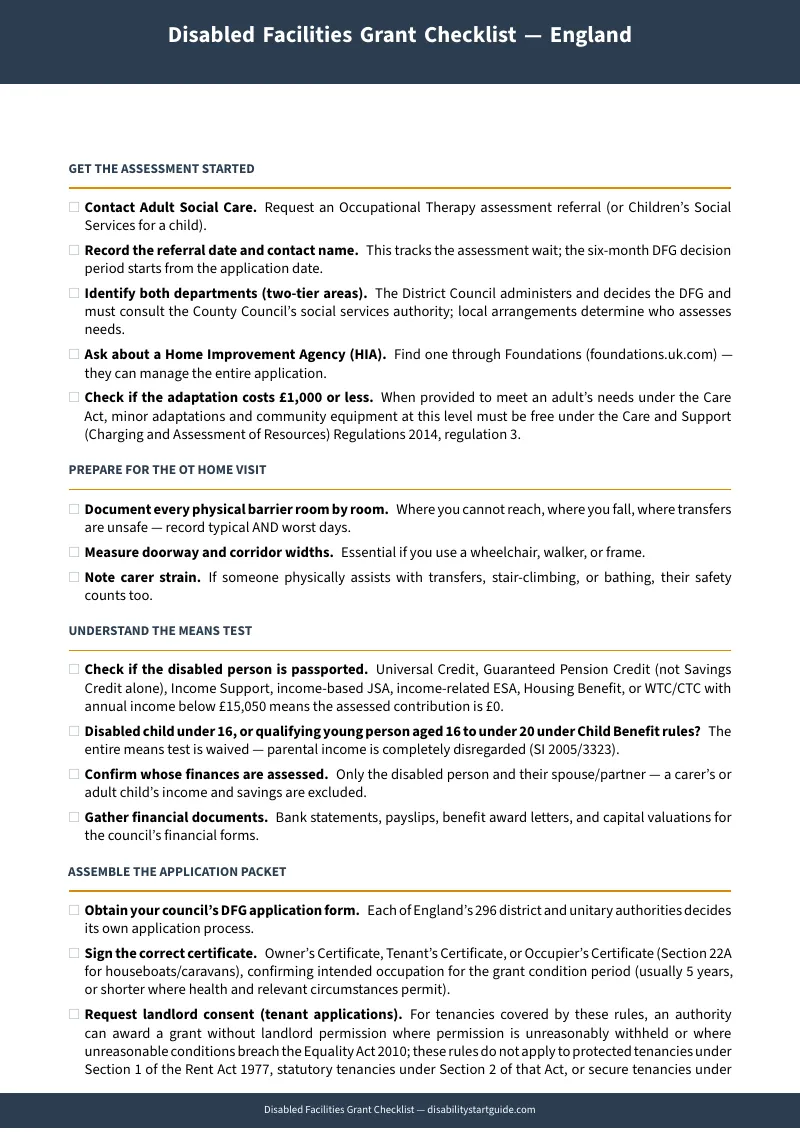
The free Disabled Facilities Grant Checklist gives you the five DFG stages at a glance — OT contact, financial documents, contractor quotes, written approval and post-completion sign-off — with links to GOV.UK and the key charity helplines.
The full kit gives you the detail behind each stage plus eight printable worksheets: the OT Need Preparation Worksheet, Financial Means Test Evidence Organiser, Council and Social Care Responsibility Map, Contractor Quote Comparison Sheet, Statutory Timeline Tracker, Agency Communication Log, Complaint and Ombudsman Escalation Log, and Legal Authority Worksheet. The checklist tells you what to do. The guide and worksheets show you how, with the statutory references and tools to hold your council to its deadlines.
Who this guide is written for
- Family carers and adult children managing a DFG application for a parent or relative — the guide is written for the person doing the administrative work, not just the person whose name goes on the form
- Disabled people applying for their own adaptation, whether you are an owner-occupier, a tenant or living with family
- Parents of disabled children — the guide covers the full parental means-test exemption and the additional rules for child adaptations
- Private tenants and landlords navigating the consent process, tenant certificates and the Equality Act obligations
- Anyone who has been refused, delayed or offered a grant that does not cover the cost — the complaints and Ombudsman sections explain how to challenge the decision
What this guide is not
This is not legal advice, and it does not promise any outcome. DFG approval depends on the OT's clinical assessment of need and the council's application of the statutory rules. The guide organises the process and your evidence — it never coaches anyone to overstate their needs, and it cannot guarantee a grant award or amount.
This is not a government publication. It is independent, with no affiliation to any local authority, the Department for Work and Pensions or any charity. Every statutory reference is cited, and the guide links to the official sources throughout.
Free help is available. Citizens Advice, your local Home Improvement Agency (find yours through Foundations), Scope, Disability Rights UK and Age UK all provide free guidance and signposting. The guide complements these services — it gives you the structured administrative toolkit that charities, constrained by caseloads, cannot provide for every applicant.
How the guide is delivered
Instant PDF download after purchase — no waiting, no shipping. The files are formatted for printing and for screen reading, with high-contrast text and clearly labelled worksheets. You get 10 PDFs: guide.pdf (the full 49-page, 13-chapter guide), checklist.pdf (the two-page, 25-item quick-reference checklist), and eight 2-page fillable worksheets — ot-need-preparation-worksheet.pdf, financial-means-test-evidence-organiser.pdf, council-and-social-care-responsibility-map.pdf, contractor-quote-comparison-sheet.pdf, statutory-timeline-tracker.pdf, agency-communication-log.pdf, complaint-and-ombudsman-escalation-log.pdf and legal-authority-worksheet.pdf.
Full refund, no time limit. If the guide is not what you expected, email [email protected] and we will refund you in full.
Frequently Asked Questions
Does this guide cover Wales, Scotland or Northern Ireland?
No. The DFG statutory framework in this guide applies to England only. Wales, Scotland and Northern Ireland each have their own adaptation grant systems with different rules, caps and application processes.
Will I definitely get a grant if I follow the guide?
No. Grant approval depends on the OT assessment, the council's application of the statutory criteria, and (for adults) the means test. The guide prepares you to present complete and accurate evidence — it does not guarantee any outcome.
I receive PIP / Attendance Allowance / DLA. Does that mean I automatically pass the means test?
Receiving these benefits does not passport you through the DFG means test. However, receiving certain income-related benefits — such as Universal Credit, Income Support, income-related ESA or Pension Credit Guarantee Credit — does. The guide lists every passporting benefit and explains what happens when you are not passported.
My adaptation will cost more than £30,000. Is there any help beyond the statutory cap?
Many councils offer discretionary top-up funding under the Regulatory Reform Order 2002. The amount and eligibility criteria vary between councils. The guide explains how to identify your council's policy and how to make a formal request.
Can I use the guide if I am a tenant, not a homeowner?
Yes. The guide has a dedicated section for tenants — private and housing association — covering landlord consent, tenant certificates, the Equality Act duties, and what happens if the landlord withholds permission.
Is the product price shown in pounds or dollars?
The price shown on this page is automatically adjusted to your local currency. You pay in the currency displayed at checkout.
Frequently Asked Questions
What if the rules change after I buy?
We update the guide when the rules change. Email us any time, even years later, and we'll send you the current edition free.