Your Blue Badge Application Shouldn't Be This Hard
You know you struggle. Your GP knows. Your family sees it every day. But somewhere between the GOV.UK eligibility checker and your council's assessment team, the system seems designed to make you prove it all over again — in a language that doesn't match how you actually experience your condition.
Thousands of people in England are refused a Blue Badge every year, not because they don't qualify, but because the evidence they submit doesn't address what councils are actually looking for. A one-line GP letter that says "this patient has mobility difficulties" isn't enough. A PIP award under Descriptor D — even at 10 points — doesn't give automatic eligibility, and many applicants don't find that out until the refusal letter arrives.
The Evidence-Mapping Approach
The Blue Badge Applications in England guide takes a different approach to the scattered advice you'll find across council websites and forum posts. Instead of listing rules and hoping you can figure out how they apply to your situation, it walks you through an evidence-mapping process — a structured way to connect your real daily experiences to the specific criteria your council assesses.
That means working through your walking distance in terms councils actually measure, documenting the psychological distress that makes journeys overwhelming, and building an evidence package that speaks directly to the route you're applying under — whether that's automatic eligibility through PIP or DLA, the assessed physical pathway, or the non-visible disability route introduced in August 2019.
What's Inside the Guide
- Every eligibility pathway explained — Automatic qualification through PIP (8+ points Moving Around, or 10 points under Descriptor E in Planning and Following Journeys), DLA Higher Rate Mobility, registration as severely sight impaired, and qualifying Armed Forces Compensation Scheme awards (tariffs 1–8 with the required disability certification), plus the assessed physical and non-visible disability routes. Each pathway includes what evidence is needed and what happens if your benefit award changes.
- Non-visible disability evidence framework — The August 2019 rules opened Blue Badge access to people with autism, severe anxiety, dementia, agoraphobia and brain injury, but councils still reject applications that don't demonstrate how a condition causes very considerable difficulty or a risk of serious harm while walking during a journey. The guide provides a structured approach to documenting flight risks, sensory overload, panic frequency and coping mechanisms with professional evidence.
- Walking and Journey Diary — For the assessed route, councils may arrange a phone assessment or an in-person walking evaluation. The 14-day diary helps you record truthful details about walking distance, pain onset, breathlessness, fatigue, use of aids, journey distress and risk events — so you can describe typical and difficult days accurately.
- Eligibility Route Finder — A printable yes/no sheet that helps you read your DWP award letter, identify which mobility descriptors you scored on and determine whether you qualify automatically or need the assessed route. This catches the Descriptor D vs Descriptor E confusion that leads to preventable refusals.
- Evidence Gathering Checklist — Documents to request by route, including identity, address, photo and third-party consent if you are applying on behalf of a family member. The guide covers how to organise evidence when you are describing someone else's daily experience.
- Renewal Timeline Tracker — Blue Badges can last up to three years and must be renewed before they expire. The tracker maps the months before expiry and explains what happens when your underlying PIP or DLA award changes, expires or is reduced on review.
- Review Request Planner — If your application has been refused, the planner walks you through matching each stated refusal ground to new evidence, drafting a covering letter, and understanding when the Local Government and Social Care Ombudsman can investigate.
- Central London parking rules — Westminster, Camden, Kensington and Chelsea, and the City of London each operate their own local badge schemes that limit what a standard Blue Badge allows. The guide explains the restrictions in each area so you are not caught out.
Who This Guide Is For
- Disabled people in England applying for a Blue Badge for the first time, whether through automatic eligibility or the assessed route
- People with non-visible conditions — autism, severe anxiety, dementia, agoraphobia, brain injury — who need help presenting evidence the council's assessment team will understand
- Family members and unpaid carers completing the application on someone else's behalf
- Parents of children under 3 whose condition means the child must always be accompanied by bulky medical equipment that cannot be carried around with the child without great difficulty, or kept near a motor vehicle so treatment can be given there or the child taken quickly by vehicle to where treatment can be given
- Existing badge holders approaching renewal, especially where a PIP or DLA award has changed
- Anyone refused a Blue Badge who wants to understand the review process and strengthen their evidence
Why Not Just Use Free Resources?
You absolutely can. GOV.UK provides the application form and basic eligibility information for free, and Citizens Advice publishes excellent guidance on the scheme's rules. This guide does not give you access to anything you cannot find through official channels.
What it does is consolidate scattered information — across GOV.UK, the Department for Transport's local authority guidance, 150+ council websites with different processes, and the actual experiences of applicants who have navigated refusals and reviews — into a single, structured workflow. The Eligibility Route Finder, Evidence Gathering Checklist, Walking and Journey Diary, Application Tracking Log, Review Request Planner and Renewal Timeline Tracker are tools that don't exist in the free ecosystem, where the advice is "gather supporting evidence" without explaining what that means in practice.
If you are comfortable navigating GOV.UK and your council's portal on your own, you may not need this guide. If you are on a low income, Citizens Advice and local welfare rights services can help for free. This guide is for people who want an independent, self-paced planning tool that organises the entire process — from working out which route to apply under to preparing for the assessment and knowing what to do if the council says no.
Satisfaction Guarantee
The guide comes with a full refund, no time limit. If it doesn't help, email [email protected] and you'll get your money back.
Start Your Application With Confidence
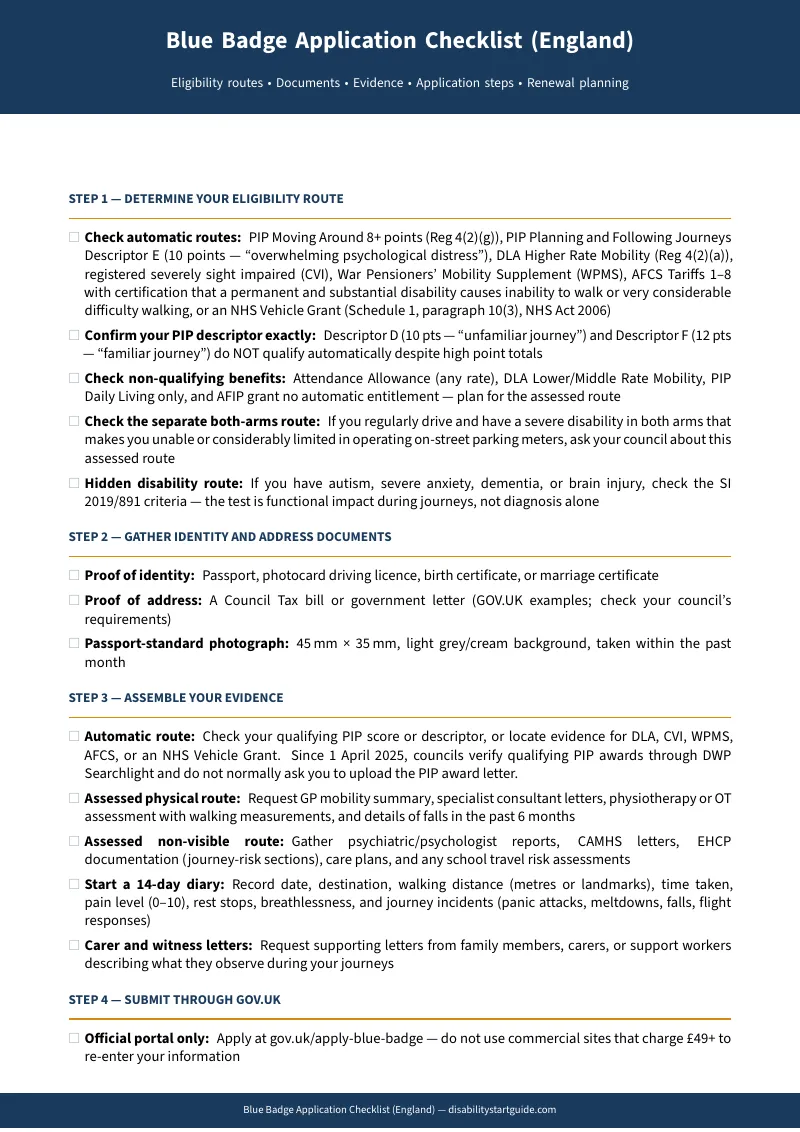
The free Blue Badge Application Checklist gives you a two-page overview of the eligibility routes, documents and steps. It's a good place to start if you want to see whether the guide covers your situation.
When you're ready for the Eligibility Route Finder, the Walking and Journey Diary and the Review Request Planner, the complete guide is available for — a one-time purchase with no subscription.
Get the Blue Badge Applications Guide →
Frequently Asked Questions
What if the rules change after I buy?
We update the guide when the rules change. Email us any time, even years later, and we'll send you the current edition free.