The DWP Got It Wrong — Now You Have One Month to Show Them Why
The decision letter says you scored fewer points than you need, or none at all. The assessor's report describes someone you don't recognise — someone who can cook, wash, get dressed and walk to the shops without difficulty. That is not your life.
You have one calendar month from the date on that letter to ask the DWP to look at the decision again. This is called a mandatory reconsideration. Miss the deadline and you lose the right to challenge through the normal route. Even with a different decision maker, vague, unstructured arguments may leave the decision unchanged.
The problem is not that you lack evidence. It is that the DWP's own system — twelve activities, each with its own descriptors, four reliability criteria, a points threshold — is designed for structured, specific input. A GP letter saying "my patient has fibromyalgia" does not score points. A description of how fibromyalgia means you cannot prepare a meal safely on most days, because fatigue and pain make you drop pans and forget the hob is on, does.
The Assessment Audit Method
This guide gives you a structured way to take apart the DWP's decision, find where the assessment report got your daily life wrong, and put that challenge on paper in the format the decision maker actually reads.
It is called the Assessment Audit Method because the central step — the one most free resources skip — is a line-by-line comparison of what the assessor wrote in the PA4 consultation report against what you actually said, what your medical evidence shows, and what your daily life looks like on a typical day and a bad day.
Free resources tell you to "explain why you disagree." This guide shows you exactly how: which descriptors to challenge, how to apply the four reliability criteria (safely, to an acceptable standard, repeatedly, within a reasonable time), how to log fluctuating symptoms using the more-than-50%-of-days rule, and how to structure the whole thing so the decision maker can follow it activity by activity.
What You Get
- Decision letter decoder — how to read which activities were awarded and refused, what the point scores mean for daily living and mobility, and where the decision is most vulnerable to challenge
- PA4 assessment report audit — a structured method for going through the assessor's consultation report paragraph by paragraph, comparing it against your own account, and flagging inaccuracies, omissions and misunderstandings
- Deadline control workflow — how the one-month deadline is calculated, how to lodge the request immediately to preserve it while you gather evidence, and how to make a late request with good reasons within 13 months
- Reliability criteria framework — how to apply the four legal tests to each activity you are challenging, with prompts for fluctuating conditions, fatigue, pain, cognitive difficulty and supervision needs
- Evidence assembly guide — what counts as supporting evidence (GP letters, specialist reports, care plans, medication records, daily logs), how to ask for it, and how to present it alongside the MR request
- Whole-award risk assessment — the DWP can increase, maintain or reduce your award on reconsideration, and the guide helps you think through whether to challenge specific activities or the entire decision
- Submission and tracking checklist — using form CRMR1, writing a letter, or calling the PIP enquiry line, with a receipt tracker for reference numbers and postal proof
- Tribunal bridge — if the mandatory reconsideration does not change the decision, the guide explains the mandatory reconsideration notice and the step to a First-tier Tribunal appeal
The guide comes with five printable worksheets: a deadline calculator and receipt tracker, a PA4 assessment audit template, a reliability logging grid for recording fluctuating symptoms over 14–28 days, a submission organiser to confirm everything is ready before you send, and a post-MR decision roadmap for all three outcomes.
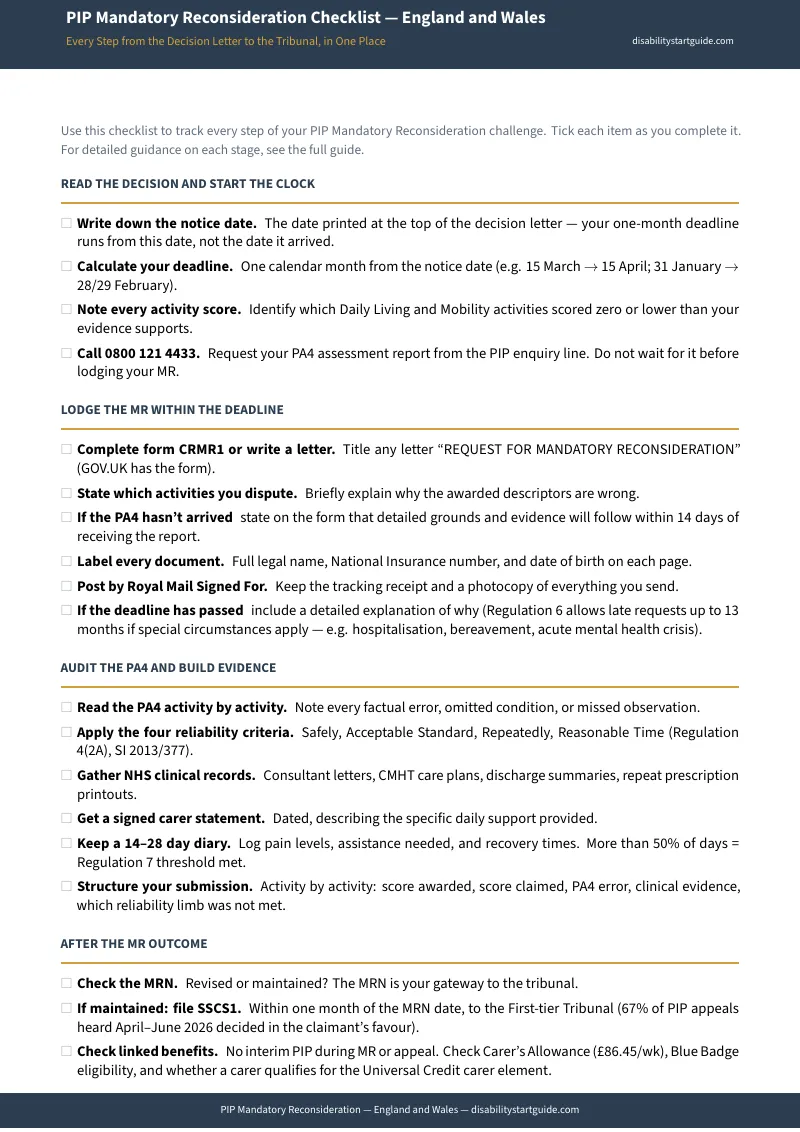
The free checklist covers the deadline, the phone number to request your assessment report, the form to use and a directory of free advice services. The full guide adds the structured audit method, the reliability framework, the evidence assembly process, the whole-award risk assessment and the printable worksheets.
Who This Is For
- A disabled person or someone with a long-term condition in England and Wales who has received a PIP decision they believe is wrong
- A carer, partner or parent helping someone challenge a decision — the guide is written for both the claimant and the person filling in the form on their behalf
- Anyone who scored zero points despite substantial daily difficulties
- Anyone whose PIP award was reduced after a routine review
- Anyone approaching the one-month deadline who needs a clear, structured way to get the challenge submitted
This guide covers England and Wales only. Scotland uses Adult Disability Payment with a separate redetermination process, and Northern Ireland has its own PIP administration through the Department for Communities.
Why Free Tools Are Not Enough
The official CRMR1 form gives you a text box and says "tell us why you disagree." GOV.UK explains the process but not how to structure a challenge. Citizens Advice is excellent — but many local offices have waiting lists longer than your one-month deadline, and telephone triage often means coaching you to self-advocate rather than completing the form for you.
Charity websites explain the descriptors in general terms. Forum threads share individual experiences. Benefits and Work offers a subscription library running to hundreds of pages. None of them give you a single, linear workflow that takes you from the decision letter to a submitted mandatory reconsideration with structured evidence.
That is what this guide does. One structured workflow, from the day the letter arrives to the day the DWP acknowledges your challenge.
Satisfaction Guarantee
Full refund, no time limit. If the guide does not help, email [email protected] and you will get your money back.
Get Started
Download the free checklist to see the deadline, the key steps and the free advice directory. When you are ready for the full structured audit method and evidence framework, get the complete guide — once, yours to keep and print.
Frequently Asked Questions
What if the rules change after I buy?
We update the guide when the rules change. Email us any time, even years later, and we'll send you the current edition free.