Your AR1 arrived. The clock is ticking. And the DWP can change everything.
A PIP award review is not a formality. The DWP Case Manager can maintain your award, increase it, reduce it, or stop it entirely — even if your condition has not changed by a single degree. Section 10 of the Social Security Act 1998 allows the DWP to supersede an earlier decision.
Most claimants treat the AR1 form like a routine update. They tick "no change," send it back, and assume their existing award carries forward. Then the decision letter arrives, and the award has gone down.
That happens because "no change" without a full restatement of your daily restrictions gives the Case Manager nothing to work with. They may not have your previous assessment report or tribunal decision in front of them. Silence looks like improvement.
The PIP Review Evidence System
This guide gives you a structured, print-ready system for completing the AR1 form and documenting your genuine needs so thoroughly that no decision-maker can reasonably conclude your situation has improved when it has not.
It is not a collection of template answers. It will not tell you what to write to score more points. What it does is walk you through the statutory tests the DWP actually applies — the Regulation 4(2A) reliability criteria (safely, to an acceptable standard, repeatedly, in a reasonable time) — and show you how to describe your real daily experience in that framework.
What's Inside
- AR1 form, section by section — what each part asks, what the Case Manager extracts from your answers, and exactly how to respond in the language the DWP looks for. Covers all 10 Daily Living and 2 Mobility activities.
- The "no change" protection method — how to restate your current restrictions under every activity heading so the decision-maker has a complete picture, even when nothing has actually changed since the last review.
- Fluctuating symptoms frequency tracker — a structured worksheet for logging good days, bad days, and the help you need across a recording period, mapped to the statutory 50% rule that governs whether a descriptor applies.
- Evidence assembly checklist — which documents to gather (repeat prescriptions, specialist letters, care plans, hospital discharge summaries), when to request them, and how to present them so they support your descriptor scores.
- Carer and third-party statement guide — how a family member, partner, or unpaid carer writes an effective supporting statement that adds objective evidence without overstepping the legal boundary between helping and misrepresenting.
- AR2 light-touch review guidance — who gets one, what the shorter form covers, what to do if the DWP switches you to a full AR1, and how 10-year ongoing awards are reviewed differently.
- Change of circumstances protocol — when you must report a change, what happens when you do, and the difference between a planned review and a change report.
- Review decision roadmap — what happens after submission (paper review, telephone or face-to-face assessment, the decision notice), and exactly what to do if the outcome is wrong: Mandatory Reconsideration using the CRMR1 form, requesting the PA4 consultation report after a consultation, and the First-tier Tribunal route.
- Passported benefits tracker — what happens to your Blue Badge, Motability Scheme access, council tax reduction, Carer's Allowance for someone caring for you, and other linked entitlements when your PIP award changes.
- Contacts and free help directory — Citizens Advice, local welfare rights services, Advicenow, condition-specific charities, the PIP enquiry line, and Relay UK details.
Who This Guide Is For
- A disabled person in England or Wales who has received an AR1 review form and wants to complete it properly — covering every activity in full, with evidence
- A family member, partner, or unpaid carer helping someone fill in the form, organise evidence, and write a supporting statement
- Anyone whose PIP award was reduced at a previous review and wants to prepare more thoroughly this time
- A claimant with a fluctuating condition (such as ME/CFS, fibromyalgia, arthritis, or a mental health condition) who needs to document variable symptoms accurately
This guide is for England and Wales only. Scotland (Adult Disability Payment via Social Security Scotland) and Northern Ireland (PIP via the Department for Communities) have separate systems with different forms and rules.
Why Not Just Use the Official Notes?
The DWP's own AR1 notes explain the basics: fill in each section, return by the deadline, call 0800 121 4433 if you need more time. What they do not explain is how to translate your daily experience into the statutory language the DWP uses to score descriptors, how to structure evidence so it supports your answers, or what to do when the decision-maker has no access to your previous assessment file.
Citizens Advice, Advicenow, and disability charities publish excellent free guidance, and you should use them. Local welfare rights services offer face-to-face help. But many claimants cannot get an appointment before the one-month return deadline, and the free guidance does not include printable worksheets for organising your evidence or a structured framework for tracking fluctuating symptoms against the 50% rule.
This guide fills that gap. It is a self-paced, print-ready workspace that complements the free help available — not a replacement for it.
The Free Checklist
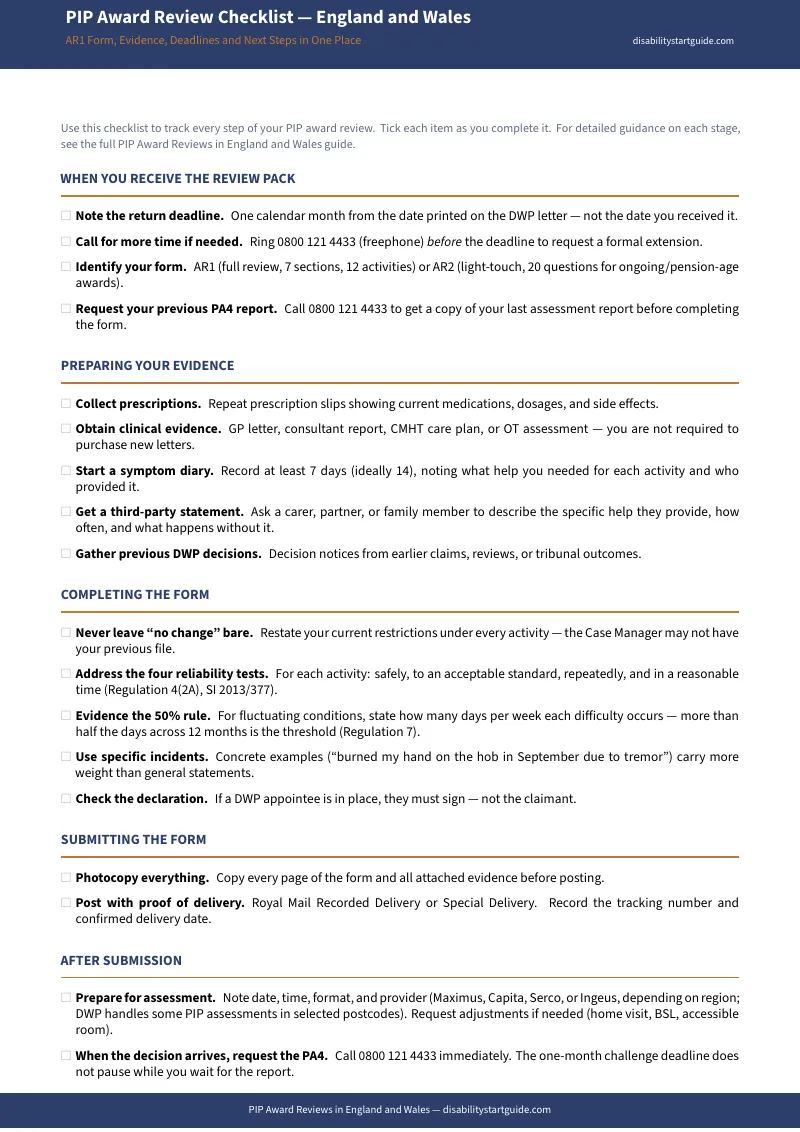
Not ready for the full guide? Download the free PIP Award Review Checklist — a two-page summary of the review timeline, essential evidence, the AR1 return deadline, the DWP extension phone number, and the four Regulation 4(2A) reliability tests. It is a useful starting point whether or not you decide to get the full guide later.
What This Guide Will Not Do
This guide will not guarantee your PIP award stays the same or goes up. No guide, adviser, or representative can do that. PIP decisions are made by DWP Case Managers based on statutory criteria.
It will not tell you what to write to maximise your points. It will not provide template answers or pre-scripted responses. Misrepresenting your functional abilities is unlawful and can result in prosecution.
What it will do is help you describe your genuine daily living and mobility needs completely, accurately, and in the language the DWP uses to make its decisions — so the Case Manager has the full picture, not a blank page.
Your Purchase Is Protected
Every purchase comes with a full refund, no time limit. If the guide is not what you expected, email [email protected] and you will receive a complete refund. No questions, no deadline.
The guide is available as an instant download: , one-time payment, yours to keep and print as many times as you need.
Frequently Asked Questions
Is this an official DWP guide?
No. This guide is completely independent. It has no connection, affiliation, or endorsement from the Department for Work and Pensions, HMCTS, Social Security Scotland, or any government department or charity.
Will this guide script my answers for me?
No. The guide shows you how to describe your actual daily experience in the statutory language the DWP uses. It never provides template answers or suggests exaggerating symptoms. Every response you write should be your own honest account.
Does the guide cover Mandatory Reconsideration and tribunal appeals?
Yes. It includes a full chapter on challenging a review decision: the CRMR1 form, the one-month MR deadline, requesting the PA4 consultation report after a consultation, and the route to the First-tier Tribunal. For in-depth tribunal preparation, the separate PIP Tribunal Appeal Guide covers the hearing process in full.
I have a fluctuating condition — does the guide help with that?
Yes. The guide includes a symptom frequency tracker designed for fluctuating conditions, structured around the statutory 50% rule. It shows you how to log good and bad days and present the pattern in a way that demonstrates whether a descriptor applies across the required period.
Can a carer or family member use this guide?
Yes. A large section of the guide is written specifically for unpaid carers, partners, adult children, and parents who help with form completion and evidence gathering. It includes guidance on writing effective third-party supporting statements.
What format is the guide in?
The guide is a downloadable PDF, ready to print or read on screen. You receive 9 PDFs: the main guide, a checklist, and 7 printable worksheets (AR1 activity response planner, evidence checklist, symptom diary, carer statement template, submission tracker, decision audit scorecard, and agency communication log) — all formatted for A4 paper.
Frequently Asked Questions
What if the rules change after I buy?
We update the guide when the rules change. Email us any time, even years later, and we'll send you the current edition free.