Your GP Has 15 Minutes. MSD Decides on the Paperwork. Are You Ready?
A standard GP consultation in New Zealand lasts about 15 minutes. In that window, your doctor has to understand your condition and help provide Work and Income with the medical information it needs: your diagnosis, how your condition affects work, and the likely duration. For the restricted-work-capacity route, if the practitioner sets a review date of less than two years, MSD assesses another benefit, such as Jobseeker Support, rather than SLP. And you start the process again.
The SLP Evidence Preparation System inside this guide exists because that 15-minute window is where most applications go wrong. It is not a medical assessment. It is a structured way to make sure your GP has everything they need before the appointment starts — so the certificate reflects how your condition actually affects your daily life.
What Makes This Different from the Work and Income Website
The official Work and Income pages explain the rules. They do not explain how those rules play out in practice — how to organise the medical information MSD considers, when a Regional Health Advisor advises MSD because eligibility is unclear, what "would otherwise require residential-level care" actually means when you are an unpaid carer, or how the income abatement bands interact with supplementary payments. This guide closes every one of those gaps.
It is not a script for what to say. It is not a promise that you will be approved. It is a structured system for documenting your situation accurately and completely, so that the people making the decision see the full picture — including the worst days, the recovery time, and the things you have stopped doing because you cannot sustain them.
What's Inside
Your download includes a 14-chapter guide (51 pages), a two-page checklist, and eight standalone printable worksheets — 10 PDFs in total:
- Route Selection Matrix — a printable worksheet to tick through the health condition route (Section 34) and the carer route (Section 40) side by side, including the partner exclusion rule and Simplified Access criteria, so you know exactly which pathway applies before you fill in a single form
- GP Discussion Summary Sheet — a fillable worksheet that maps your functional limitations to the 15-hour weekly work-capacity threshold and organises them for your doctor to read at the start of the consultation
- 14-Day Functional Impact Log — a printable daily tracker for typical days, worst days and recovery days, built specifically for fluctuating conditions like ME/CFS, fibromyalgia, bipolar disorder and chronic pain, so the evidence captures the variability that a single consultation cannot
- Carer Care-Level Audit — for unpaid carers, a fillable worksheet that aligns your daily care activities with the institutional threshold MSD applies: would the person otherwise need rest home, hospital-level, residential disability, eligible extended care for a severely disabled child or young person, or equivalent care?
- Income Abatement Calculator — a fillable worksheet with April 2026 net and gross rates for key categories (single, couple, sole parent, 16–17), the $160 threshold, the 30% and 70% bands, and the personal-earnings rules ($20 for other eligible health-route recipients, all personal earnings disregarded for totally blind recipients, and no exemption for carers), with space to work through your own numbers
- Supplementary Payment Map — a reference card covering Disability Allowance, Accommodation Supplement and other extra help you can claim alongside SLP, with eligibility criteria for each
- MAB Hearing Preparation Checklist — evidence categories, preparation steps and the 3-month deadline to request a medical review, which can lead to an MAB appeal, plus the Benefits Review Committee route for non-medical decisions
- Application Document Tracker — application documents and evidence, with checkboxes and space to record dates submitted to help keep the process organised in the 20-working-day window
Who This Is For
- You have a long-term health condition, injury or disability and you are applying for SLP or being moved from Jobseeker Support with a medical deferral
- You are a family member or unpaid carer filling in the forms for someone who cannot manage the process alone
- You are a parent of a young person approaching 16 who may become eligible for SLP
- Your SLP application has been declined and you need to understand the appeal routes
- You provide full-time home care for a non-partner family member and want to know whether the carer route is realistic
Why Not Just Use the Free Information?
Free information exists, and some of it is genuinely good. Citizens Advice Bureau volunteers can help you identify which benefit to apply for. Auckland Action Against Poverty offers free advocacy for people dealing with Work and Income. Community Law Centres offer free initial legal advice; Legal Aid may be available for a qualifying appeal to the Social Security Appeal Authority, but not for Work and Income review proceedings.
What none of these sources provide is a structured, self-paced evidence preparation system that you can work through at home, at your own speed, before any appointment or form. The official Work and Income website lists the rules but does not show you how to document your daily functional limitations against the specific criteria MSD applies. Forum posts share experiences but not frameworks. Advocacy services are invaluable — and this guide lists them in its resources chapter — but appointment waiting lists mean many applicants need to start preparing before a human advocate is available.
This guide sits alongside those resources. It organises the preparation work so that when you do see your GP, speak with an advocate, or submit your application through MyMSD, you have everything ready.
Your Purchase Is Protected
Full refund, no time limit. If the guide is not what you expected, email [email protected] and you will get your money back. No deadline, no questions.
Take the First Step
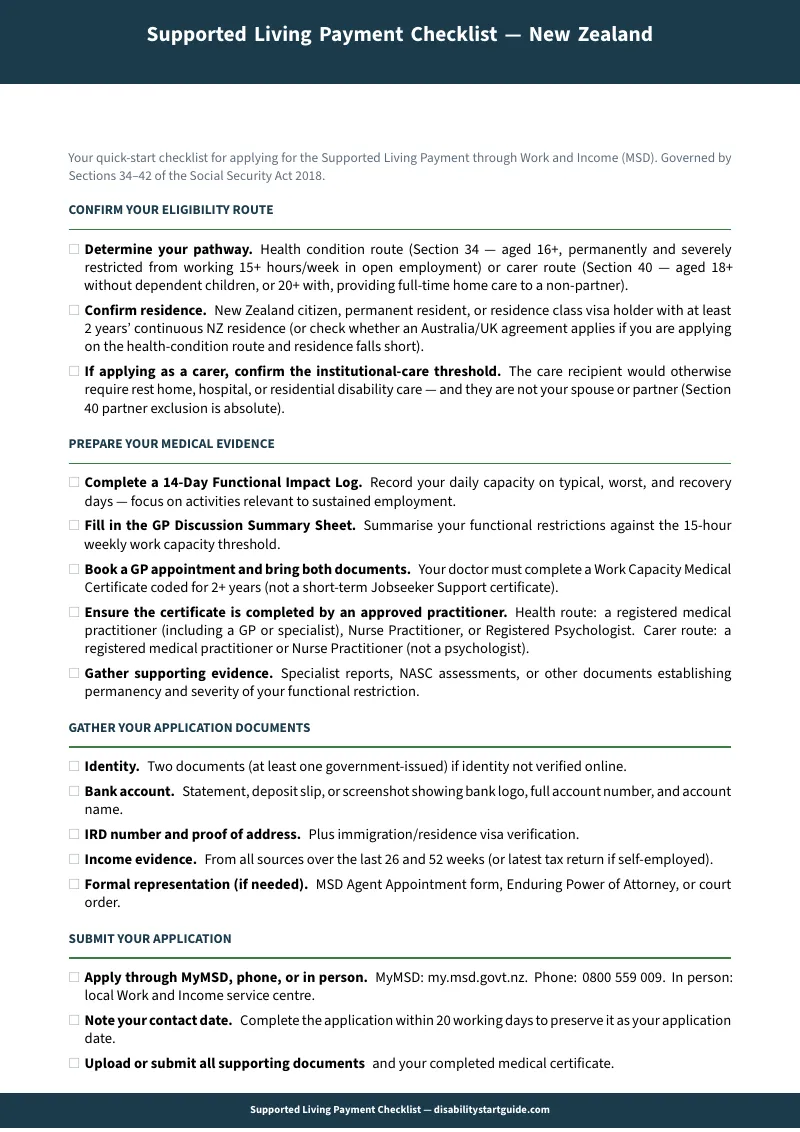
Download the free Supported Living Payment Checklist to see a quick eligibility and application overview at a glance. When you are ready for the complete system — 10 PDFs including the evidence logs, the GP Discussion Summary Sheet, the income abatement calculator, the appeal preparation checklist and the 51-page guide — the full kit is here.
Get the full Supported Living Payment Guide →
Frequently Asked Questions
Is this guide affiliated with Work and Income or the Ministry of Social Development?
No. This is an independent guide published by Disability Start Guide. It is not produced by, endorsed by or affiliated with MSD, Work and Income, or any government agency or charity. It explains the process in plain language and points you to free help throughout.
Will this guide tell me what to say to get approved?
No. The guide provides structured frameworks for documenting your actual functional capacity accurately and completely. It does not provide scripts, suggest exaggerating symptoms, or promise any outcome. The goal is to make sure the people making the decision see the full picture of how your condition affects your daily life.
I'm on a low income — can I justify spending money on this?
The free checklist gives you the eligibility overview and application steps at no cost. The paid guide adds the evidence preparation system, the functional impact log, the GP Discussion Summary Sheet, and the appeal framework. If free advocacy services can help you prepare, that may be all you need — and the guide lists those services in its resources chapter. The paid guide is for people who want to prepare independently or whose advocate appointment is weeks away.
Does the guide cover the carer route?
Yes. The guide covers both the health condition route and the carer route in full, including the partner exclusion rule, the institutional care-level threshold, Form M113-MCW, and how to document daily care activities against MSD's criteria.
What if my application is declined after using this guide?
The guide includes a full chapter on reviews and appeals — the Medical Appeals Board for medical decisions and the Benefits Review Committee for non-medical decisions. It cannot guarantee any outcome, but it explains the deadlines, the process, and how to prepare your evidence for a hearing. Community Law Centres offer free initial legal advice, and regional advocacy services can support you through the process; Legal Aid may be available for a qualifying appeal to the Social Security Appeal Authority, but not for Work and Income review proceedings.
Frequently Asked Questions
What if the rules change after I buy?
We update the guide when the rules change. Email us any time, even years later, and we'll send you the current edition free.