You have the benefit letter. Now what?
You received a PIP decision, a DLA renewal, or a letter from your consultant — and somewhere in the conversation, someone mentioned the Blue Badge. So you searched. And you found council websites that explain the rules in fragments, forum threads full of contradictory advice, and no clear answer to the question that actually matters: does your situation qualify, and what evidence will the council accept?
Welsh councils reject applications every day — not because people don't qualify, but because they submit the wrong evidence. A short GP letter confirming a diagnosis. A benefit award that doesn't meet the specific point threshold. A cognitive impairment application with no supervision log. The council's assessor needs functional evidence of how your condition affects your daily mobility, and most applicants don't know what that looks like until after the refusal.
The Wales Blue Badge Evidence Navigator
This is not a summary of the rules you can already read on GOV.WALES. The Blue Badge Applications in Wales guide maps every eligibility route to the specific documents, evidence formats and council workflows that determine the outcome — from automatic qualification through PIP mobility points to assessed routes for walking impairment, cognitive conditions and temporary disabilities.
The 47-page guide and planning tools give you a structured process for each stage of the application, from working out which route applies to your situation through to renewals three years later.
What You Get
- Eligibility route finder — a clear breakdown of automatic qualification (PIP Mobility Activity 2 at 8+ points, Activity 1 Descriptor F at 12 points, Higher Rate Mobility DLA, Severe Sight Impairment, War Pensioners' Mobility Supplement, Armed Forces Compensation Scheme Tariffs 1–8 including permanent mental disorder under Tariff 6) and all five discretionary categories plus the separate temporary route, so you know exactly where you stand before you start
- Evidence portfolio builder — the specific functional evidence Welsh councils accept for each route, including what to request from specialists, how to document walking distances and pain levels, and why a diagnosis-only GP letter is not enough
- Cognitive impairment and carer supervision log — a structured framework for documenting journey planning difficulties, wandering risks and constant supervision needs, designed for carers supporting someone with dementia, autism or a learning disability
- Mobility assessment preparation toolkit — what happens during the council's independent mobility assessment, what the assessor looks for, and how to communicate your walking limits, breathlessness and aid usage accurately on the day
- Council review and escalation guide — what to do when the answer is no: the internal review process, what new evidence to gather, the Monitoring Officer route, and when to escalate to the Public Services Ombudsman for Wales
- Application timeline tracker — helps you track application dates, assessments and decisions and keep the 12-week renewal window in view
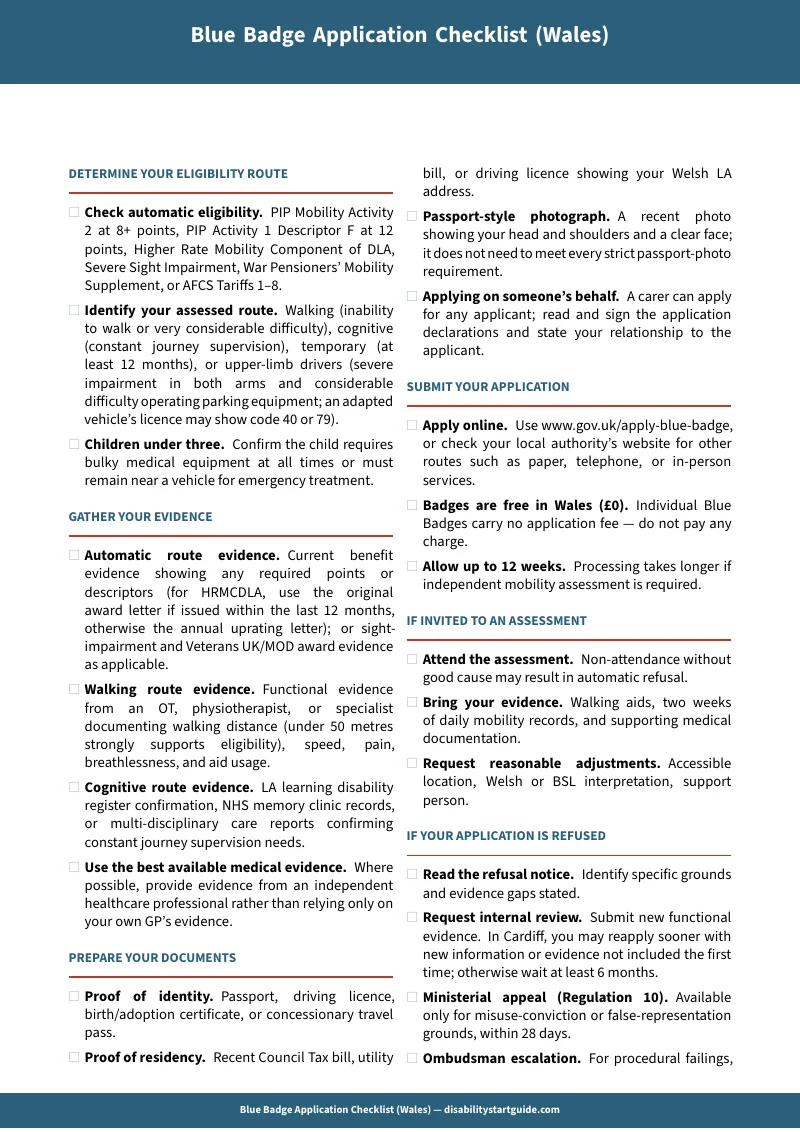
- Application document checklist — the free printable checklist covers identity documents, residency proof, photo requirements, benefit evidence and the GOV.UK portal steps
Who This Is For
- A disabled person in Wales applying for a Blue Badge for the first time
- A family member or unpaid carer completing the application on someone's behalf
- A parent applying for a child under three who needs a badge for bulky medical equipment
- Someone whose application was refused and who wants to understand the review process
- An existing badge holder approaching their three-year renewal
What Free Resources Cover — and Where They Stop
The official guidance on GOV.WALES explains the eligibility criteria and links to the application portal. Citizens Advice Cymru offers free advice, and Disability Wales provides information and signposting; the guide lists their contact details. What none of these provide is a consolidated, printable toolkit that maps your specific route to the evidence the council needs, prepares you for an independent mobility assessment, and walks you through the review process if the first answer is no.
Council websites explain the rules across separate pages, PDFs and portals. The guide puts one application — yours — in order from start to finish.
Important: What This Guide Does Not Do
This is an independent educational guide. It is not affiliated with or endorsed by the Welsh Government, any local council, DWP or any statutory body. It does not provide legal or medical advice, does not predict council decisions, and never suggests exaggerating or inventing symptoms. The Blue Badge application is free, and the badge itself costs nothing (£0) in Wales — this guide sells organisation and clarity, not access to the scheme.
Free help is always available. Citizens Advice Cymru, Disability Wales, local welfare rights units and condition charities all provide support at no cost. This guide is for people who prefer a structured, printable toolkit they can work through independently.
Satisfaction Guarantee
Full refund, no time limit. If the guide does not help, email [email protected] and you will receive a complete refund — no questions, no deadline.
Start Your Application With the Right Evidence
Download the free checklist to see the essential steps at a glance — or get the full Blue Badge Applications in Wales guide for and work through the complete evidence-building process, assessment preparation and review framework.
Frequently Asked Questions
What if the rules change after I buy?
We update the guide when the rules change. Email us any time, even years later, and we'll send you the current edition free.