The PIP2 form is sitting on the table. You have a month to get it right.
The form asks how your condition affects your daily life — preparing food, washing, dressing, getting around, taking medication, talking to people — twelve activities in all, each scored on points you cannot see. Miss a detail about your worst days, leave out how long things really take, or forget to mention the help you need but don't get, and the decision may not reflect what you actually live with.
Free guidance on GOV.UK explains the rules, but it does not show you how to turn your daily reality into answers the DWP can score. Charity helplines are valuable, but local Citizens Advice branches and welfare rights teams often have appointment waits that run past your form deadline. And most marketplace PDFs are generic overviews that skip the scoring detail and the evidence that supports it.
The PIP Claim Navigator: from the first phone call to the decision letter
This guide puts the entire claim process in order — what happens at each stage, what to write, which evidence matters, and what to expect at the assessment — so you or the person helping you can work through the PIP2 form accurately, completely, and without guessing.
It is written for the person claiming and for the partner, adult child, parent or carer doing the writing. It is not medical or legal advice, not affiliated with the DWP, and does not promise an award or any particular amount. What it does is show you how the twelve activities are scored and how to describe your daily life clearly under the rules the DWP actually applies.
What's inside
- The claim timeline, stage by stage — from the initial phone call through the PIP2 form, the assessment and the decision letter, with the deadlines that matter and what to do if you need more time
- All 12 activities broken down — what each daily-living and mobility activity is really asking, how the descriptors work, how points add up, and where the standard-rate and enhanced-rate thresholds sit
- How to describe fluctuating conditions — the "majority of days" rule, the four reliability tests (safely, to an acceptable standard, repeatedly, in a reasonable time), and how to explain good days and bad days without understating or overstating anything
- Evidence that supports a claim — what counts as supporting evidence, what the DWP actually does with it, how to gather functional evidence without paying for private GP letters, and how to organise everything before you send the form
- Assessment preparation — what happens at telephone, video and face-to-face assessments, what the health professional is checking, who can come with you, and how audio recording works
- Reading the decision — how to match the points on your decision letter against what you reported and spot where something may have gone wrong
- How PIP affects other benefits — carer premiums, the severe disability premium, Blue Badge eligibility, Motability, council tax reductions, and the passported benefits an award can unlock
- Where free help is — Citizens Advice, local welfare rights services, DIAL, Scope, condition charities and Advicenow, with what each one offers and how to get in touch
Who this guide is for
- You have a disability or long-term health condition and live in England or Wales
- You are about to call the PIP claim line for the first time, or the PIP2 form has arrived and you need to return it
- A family member, partner, adult child or unpaid carer is helping you with the form
- Your condition fluctuates — pain, fatigue, cognitive fog, anxiety — and you are not sure how to describe the variation on the form
- You want to understand the scoring before a charity appointment comes through, or there is no appointment available in time for your deadline
This guide covers England and Wales only. If you are in Scotland, the Adult Disability Payment guide covers the Scottish system. If you are in Northern Ireland, the Northern Ireland PIP guide covers the differences there.
Why not just use the free resources?
You should use the free resources — and this guide lists every one of them. GOV.UK sets out the legal rules. Citizens Advice explains your rights. Condition charities cover how specific diagnoses interact with PIP. None of that is wasted.
What free resources generally do not do is put the whole claim in one place, walk you through the form activity by activity with the scoring criteria alongside, explain the reliability rules with enough detail to apply them to fluctuating symptoms, and show you how to organise evidence before you send the form. That is the gap this guide fills. If the free resources give you everything you need, you do not need to buy this.
What you get
Your download includes 7 PDFs:
- The full guide — 43 pages covering every stage from the first call to the decision, with the 12 activities, evidence, assessment preparation and benefit interactions
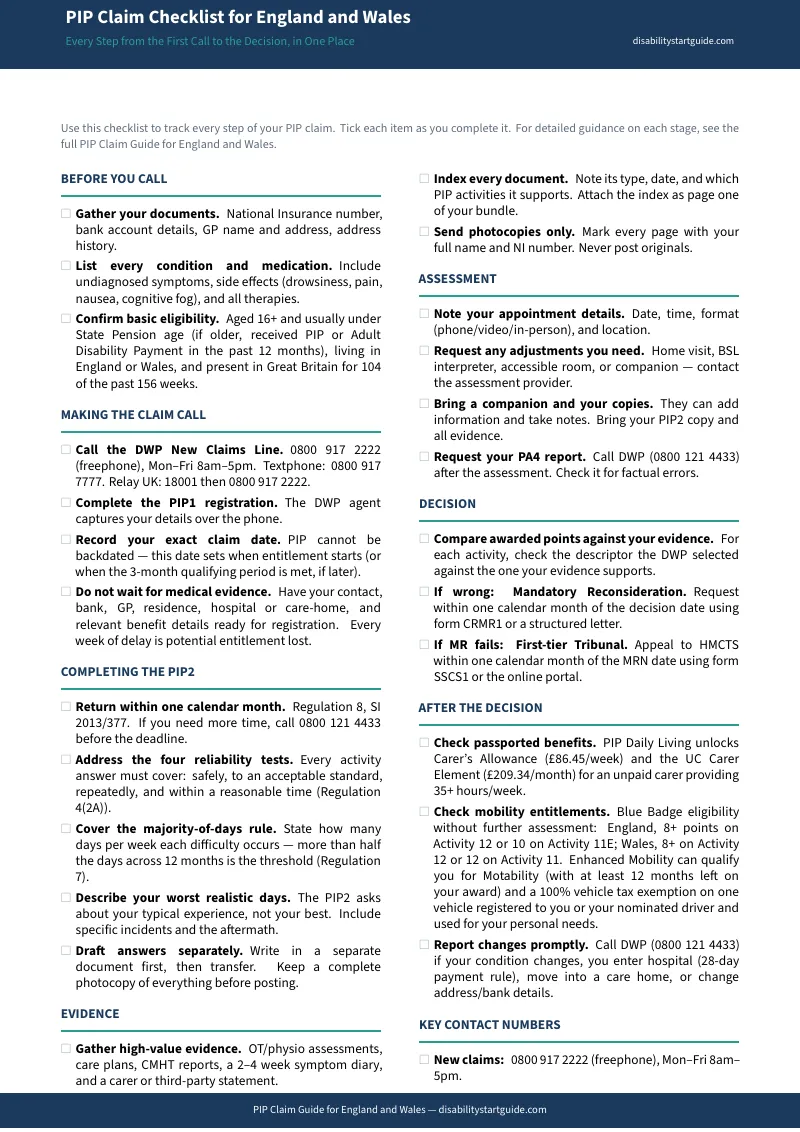
- The PIP claim checklist — a printable checklist of the claim stages, the PIP2 sections, the evidence to gather and the deadlines, so you can track where you are
- Claim Timeline Tracker — a fillable sheet for recording every date, reference number and contact from the initial call through to the decision
- Activity-by-Activity Drafting Worksheet — plan your PIP2 answers for all 12 activities against the four reliability tests before you write on the form
- Evidence Index Sheet — catalogue every document in your evidence bundle with the activities it covers, ready to attach as the first page
- Decision Audit Scorecard — compare the DWP's awarded points against the descriptors you believe apply, activity by activity
- Symptom Diary Template — a daily log structured around the reliability tests for 2–4 weeks of evidence on fluctuating conditions
Both are yours to keep. Full refund, no time limit — email [email protected] if the guide is not what you expected.
Start with the free checklist
Not ready to commit? Download the free PIP Claim Checklist — a two-page overview of the claim stages, the form sections and the evidence to gather. If the checklist is enough, that is fine. If you want the full detail, the guide is here when you need it.
Frequently Asked Questions
What if the rules change after I buy?
We update the guide when the rules change. Email us any time, even years later, and we'll send you the current edition free.