The assessment letter has arrived. You have days to work out what happens next.
A health professional is going to ask how your condition affects your daily life — preparing food, washing, dressing, getting around, managing treatments, communicating — and write a report that feeds directly into the DWP's decision. The consultation might be a phone call, a video call, a face-to-face appointment or a home visit. You might get a paper-based review instead. You don't get to choose which format, but you do get to ask for adjustments.
The problem isn't a lack of information. GOV.UK explains the rules. Citizens Advice explains your rights. Condition charities cover how specific diagnoses interact with PIP. But the official DWP PIP Assessment Guide runs to hundreds of pages of provider instructions spread across three parts, and most free sources summarise the process without showing you how the health professional actually scores your answers against each activity descriptor, or how to describe fluctuating conditions under the reliability criteria that determine whether your worst days count.
The Assessment Decoder: every format, every question, every right
This guide puts the entire PIP assessment process in one place — from decoding the appointment letter through to reading the PA4 assessment report — under the current Functional Assessment Service contracts in England and Wales. It covers all five assessment formats so you know exactly what to expect, and it explains the daily-living and mobility activities with the scoring criteria alongside, so you can describe your situation accurately and completely rather than guessing what the assessor is looking for.
It is written for the person being assessed and for the partner, adult child, parent or carer helping them prepare. It is not medical or legal advice, not affiliated with the DWP or any assessment provider, and does not coach anyone to exaggerate or invent difficulties. What it does is show you how to give an honest, thorough account of how your condition affects daily life on typical and worst days — the kind of account that reflects what you actually live with.
What's inside
- The appointment letter decoded — what it tells you, what the deadlines mean, which health assessment provider (Capita, Maximus, Serco, Ingeus or DWP for some postcodes) covers your area, and what to do if the date or format doesn't work
- All five assessment formats — how telephone, video, paper-based, face-to-face and home visit assessments run, with what differs between them and when you can request a different channel
- Reasonable adjustments under the Equality Act 2010 — how to ask for a home visit, a ground-floor room, an interpreter, large print or extra time, and the legal basis for these requests
- Welsh-language service — how to request it under the DWP's Welsh Language Scheme
- Companion rules — who can come with you, what companions are allowed to say, when the assessor should record companion evidence, and what changes during physical examinations
- Recording rules — how default audio recording works for telephone and face-to-face assessments, how to opt out, why video assessments can't currently be recorded, and the rules on personal devices
- How to describe fluctuating conditions accurately — the "majority of days" rule and the four-part reliability test (safely, to an acceptable standard, repeatedly, in a reasonable time), with practical examples of how to explain good days and bad days without understating or overstating anything
- What the assessor is checking — the 12 daily-living and mobility activities explained with their descriptors and points, plus the informal observations the health professional may note during the consultation
- The PA4 assessment report — what's in it, how to request a copy before the decision is made, how to check whether it accurately reflects what you told the assessor, and what to do if it doesn't
- PIP rates and worked examples — current standard and enhanced rates for daily living and mobility (2026/27), with two step-by-step scenarios showing how points translate into weekly payments
- Where free help is — Citizens Advice, welfare rights services, DIAL, Scope, condition charities and Advicenow, with what each offers and how to get in touch
Who this guide is for
- You have received a PIP assessment appointment letter and want to know what will happen
- You are preparing for a telephone, video or face-to-face assessment and want to describe your condition accurately under the reliability criteria
- A family member, partner or carer is going with you as a companion and needs to understand what they can and cannot do
- Your condition fluctuates — pain, fatigue, cognitive fog, sensory overload, anxiety — and you are unsure how to explain the variation to the assessor
- You have had an assessment and want to understand or check what the PA4 report says before the decision is made
- You want to prepare now rather than wait for a charity appointment, or you want to understand the process alongside the help you receive
This guide covers England and Wales only. If you are in Scotland, the assessment process is different under Adult Disability Payment. If you are in Northern Ireland, PIP is administered separately by the Department for Communities.
Why not just use the free resources?
You should use the free resources — and this guide lists every one of them. GOV.UK explains the legal framework. Citizens Advice covers your rights as a claimant. Condition charities like Mind, the MS Society and the National Autistic Society produce specialist factsheets. None of that is wasted.
What free resources generally do not do is cover all five assessment formats under the current FAS contracts in one place, explain how the health professional scores each activity descriptor, break down the recording and companion rules format by format, or give you structured worksheets for organising your evidence before the consultation. The DWP's own Assessment Guide does — but it is written for providers, runs to hundreds of pages, and does not tell you how to use it as a claimant. That is the gap this guide fills. If the free resources give you everything you need, you do not need to buy this.
What you get
Your download includes 7 PDFs:
- The full guide — 48 pages covering the appointment letter, all five assessment formats, reasonable adjustments, companion and recording rules, how to describe daily life accurately, the 12 activities with descriptors, the PA4 report, current rates with worked examples, and key contacts
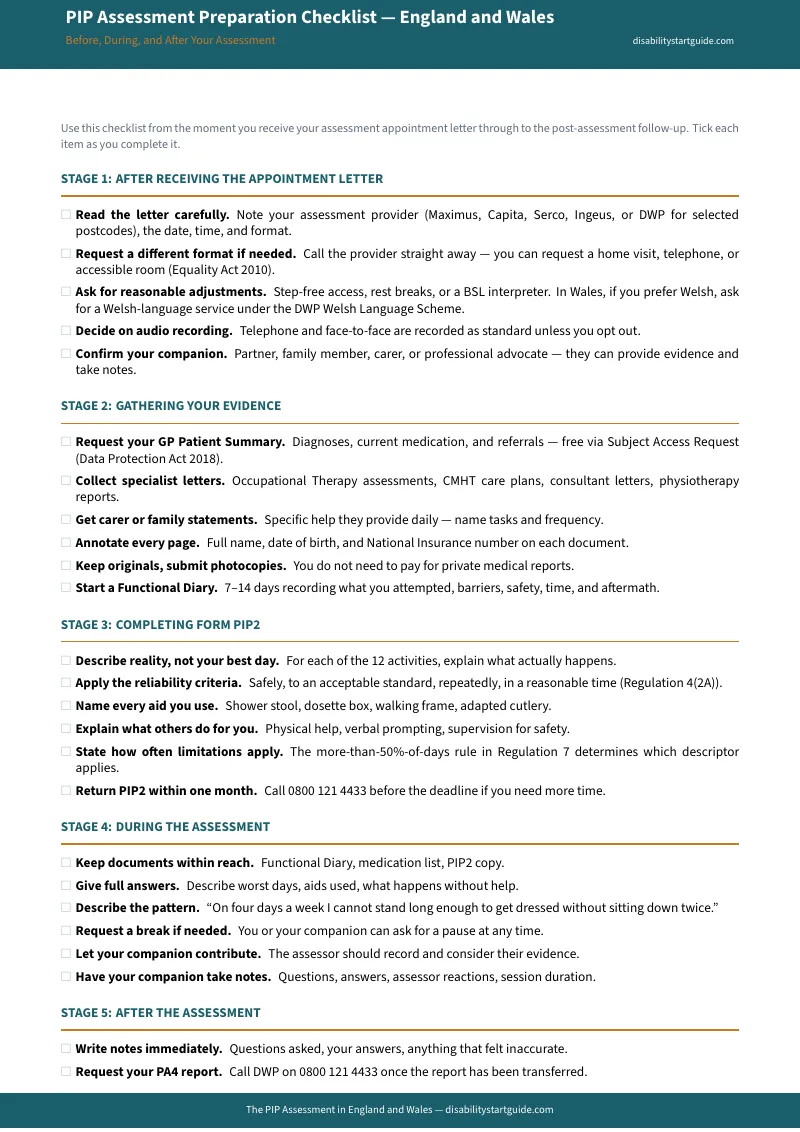
- The PIP Assessment Preparation Checklist — a printable checklist covering what to request, bring and note before, during and after the assessment
- Functional Diary Template — a 14-day log for recording how your condition affects daily living and mobility activities, with a summary section
- Assessment Day Checklist — a single-page tick-off list of everything to gather, bring and remember on the day
- Companion Note-Taking Sheet — a form for your companion to record questions asked, answers given and their own observations during the assessment
- PA4 Discrepancy Log — a comparison table for checking the assessment report against your evidence and notes
- Reliability Criteria Evidence Organiser — a worksheet for assessing your own function against the four-part reliability test across all 12 PIP activities
Both are yours to keep. Full refund, no time limit — email [email protected] if the guide is not what you expected.
Start with the free checklist
Not ready to commit? Download the free PIP Assessment Preparation Checklist — a two-page overview of what to do before, during and after the assessment. If the checklist is enough, that is fine. If you want the full detail on every format, the reliability criteria, the recording rules and the activity descriptors, the guide is here when you need it.
Frequently Asked Questions
What if the rules change after I buy?
We update the guide when the rules change. Email us any time, even years later, and we'll send you the current edition free.